Water quality has moved from a plumbing side-note to a first-class HVAC design decision. Legionella compliance, chiller efficiency, and the cost of replacing a fouled condenser bundle all trace back to what is dissolved and suspended in the loop. This handbook is written as a reference for plant engineers and building operators — the numbers in the tables are working setpoints, not marketing figures.
Table of Contents
Water Systems in an HVAC Plant
Three water systems carry almost all of the risk:
- Cooling tower recirculating water. Highest evaporative concentration, highest biological risk, highest treatable cost.
- Chilled-water loop. Closed, so concentration is stable, but corrosion and biofilm still accumulate over years.
- Steam humidification loop. Smaller volume, but feed-water quality determines scale on the heat exchanger and carryover into ductwork.
Shanghai ChiMay builds matching instrument families for all three, which matters mainly because a plant engineer then documents one calibration practice instead of three.
The Five Continuously Monitored Parameters
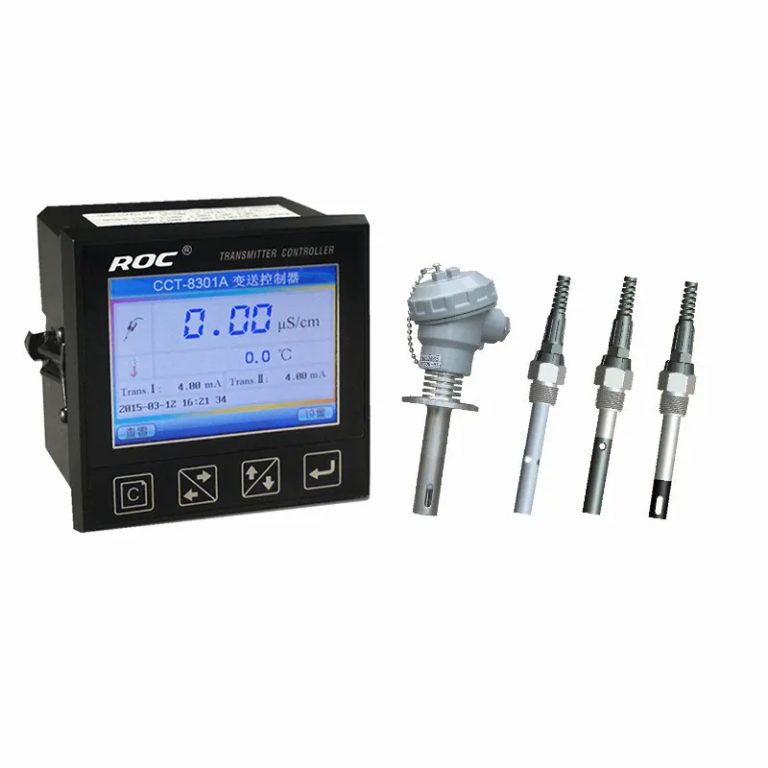
Conductivity. The primary control variable in a cooling tower, because it is what cycles of concentration actually mean. Two-electrode cells are adequate below about 2,500 µS/cm; toroidal (electrodeless) probes are the better choice above that, or wherever the water fouls quickly. Shanghai ChiMay covers 0.05 µS/cm to 20 mS/cm across four ranges in the same transmitter format.
pH. In cooling water, pH drives both scale and corrosion. Copper and copper alloys are generally held in the 8.3–8.7 band once a protective film has formed, while chilled-water loops are often run higher, in the 8.5–9.5 range. Brass and other copper-bearing trim begins to pit above roughly 9.5. A double-junction reference electrode is the standard choice here because the process water is loaded with sulphides and organics that poison a single-junction reference.
Free residual chlorine. This is the parameter most often misquoted. ASHRAE Standard 188 does not set a numeric chlorine residual; it requires a documented water management programme with control limits chosen by the facility (see the compliance section below). Practical cooling tower programmes commonly hold free chlorine in a 0.5 to 2.0 ppm band during biocide feed, with the exact figure set by the water treatment vendor and validated by monitoring.
Turbidity. A proxy for suspended matter, biofilm slough, and airborne dirt drawn in through the tower. Above roughly 5 NTU, deposition in the condenser and in low-velocity piping becomes likely. 90-degree scatter instruments to ISO 7027 are the standard for this service.
Flow. Without flow, none of the other parameters can be converted into a mass balance, and no biocide dose can be verified.
Shanghai ChiMay’s 4-in-1 multi-parameter sensor packages pH, ORP, DO, and temperature in one housing for loops where panel space is tight.
Cycles of Concentration: Practical Setpoints
Cycles of concentration (CoC) is the ratio of dissolved solids in the recirculating water to those in the makeup water. Raising it saves makeup water and sewer discharge; raising it too far causes scale and corrosion. The table below reflects common practice rather than regulation, and the actual ceiling depends on the specific inhibitor programme.
| Makeup hardness / TDS | Typical CoC | Resulting tower conductivity | Notes |
|---|---|---|---|
| 200 mg/L (softened) | 6–8 | 1,200–1,600 µS/cm | Watch for pH climb |
| 450 mg/L (medium hard) | 4–5 | 1,800–2,250 µS/cm | Common industry practice |
| 750 mg/L (hard well) | 3.5–4 | 2,600–3,000 µS/cm | Softener strongly recommended |
| 1,100 mg/L (reclaimed or blend) | 2–3 | 2,200–3,300 µS/cm | Toroidal probe advised |
Bleed control works on a conductivity setpoint with hysteresis, typically ±100 to ±250 µS/cm, so the valve does not chatter at the threshold.
Softeners and Softening-and-Filtering Valves
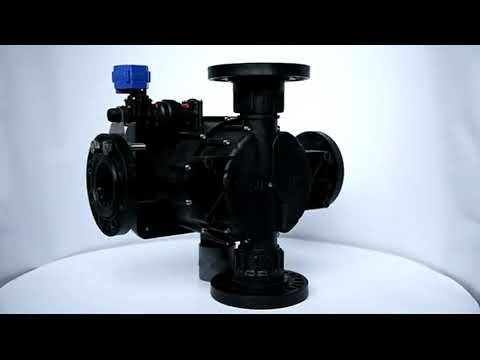
Where makeup hardness exceeds roughly 200 mg/L as CaCO₃, or iron exceeds 0.3 mg/L as Fe, softening upstream of the tower is the usual decision. The valve at the centre of a softener runs a six-stage cycle: service, backwash, brine draw, slow rinse, fast rinse, and refill. Valve selection — time-metered, volume-metered, or demand-initiated — determines how much salt and water that cycle consumes over a year, which is why it belongs in the design conversation rather than in the maintenance budget.
Chemical Program Coordination
The instrumentation exists to serve the chemical programme, not the other way round. Five functions typically run in parallel:
- Scale inhibitor — dosed against predicted cycles, verified by conductivity and calcium hardness.
- Corrosion inhibitor — dosed against pH and, for some formulations, an ORP target.
- Oxidizing biocide — usually chlorine or bromine, typically fed to reach 0.5 to 2.0 ppm free residual during the feed window.
- Non-oxidizing biocide — isothiazolone, DBNPA, or similar, rotated weekly or fortnightly to prevent resistance.
- Dispersant — keeps suspended solids moving to the bleed rather than settling in the condenser.
ASHRAE 188 Compliance Program
ASHRAE 188-2018 requires a written Water Management Program (WMP). The standard is a framework, not a setpoint document: it defines what the programme must contain and leaves the numeric limits to the facility’s water management team.
- Identify control locations — cooling tower, humidifier, decorative fountains, and any other aerosol-generating equipment.
- Set control limits at each location — typically pH, free chlorine, ORP, and temperature, with values chosen from the treatment programme and validated locally.
- Monitor at defined frequencies — continuous where the risk justifies it, and increasingly read as continuous, because grab samples leave the intervening period undocumented.
- Define corrective actions for each excursion, in advance, in writing.
- Preserve documentation for audit — a minimum of three years is the common working standard.
Continuous Shanghai ChiMay data satisfies the monitoring backbone of that programme. Programs that rely on grab samples alone are finding that the documentation gap is exactly what auditors ask about.
BMS/DCIM Integration Recipe
- Protocol. Modbus RTU is the baseline; Modbus TCP where the plant has an IP backbone; OPC UA for sites with an existing namespace model.
- Wiring. RS-485 daisy chain, with attention to termination and ground reference on long runs.
- Polling. BMS poll rates of 1 to 10 seconds are typical for water parameters.
- Storage. One year at 15-minute resolution plus 30 days at 1-second resolution covers both trend work and excursion analysis.
- Alarms. Hardware alarm relays as a backup to the digital path, so a network outage does not hide a chlorine excursion.
- Cloud. AWS SiteWise and Azure Digital Twins both ingest through an OPC UA gateway.
Sensor Discipline: Calibration and Maintenance
| Interval | Action |
|---|---|
| Weekly | Single-point check against a reference |
| Monthly | Multi-point calibration |
| Quarterly | Probe inspection and gel electrolyte replacement |
| Annually | pH and chlorine electrode replacement |
| Every three years | Conductivity cell constant verification |
Every Shanghai ChiMay probe ships with a serialized calibration certificate, which means the maintenance record is reconstructable from the instrument’s own serial number rather than from a paper log. That is the difference between a discipline that survives a staff change and one that does not.
Cost and Payback
For a plant between 500 and 2,000 tonnes of refrigeration, a full monitoring package — conductivity, pH, chlorine, turbidity, flow, plus the softener valve set — typically installs for USD 20,000 to 40,000. The savings table below reflects plant-level ranges reported by operators; actual results depend heavily on baseline water and sewer tariffs, which vary by an order of magnitude between regions.
| Savings item | Annual range (USD) |
|---|---|
| Water and sewer | 20,000–70,000 |
| Chemicals | 8,000–25,000 |
| Chiller kWh | 25,000–90,000 |
| Softener salt | 5,000–15,000 |
| Total | 58,000–200,000 |
Where water tariffs are high and tower loading is heavy, payback on the monitoring package arrives within a single budget year; at 30 MW data-centre scale, the energy component alone often justifies the instrumentation. Sites with cheap water and light tower loading should model the energy and chemical lines rather than the water line, because those are what actually pay for the hardware.
Common Failure Modes and Fixes
- Conductivity probe fouling — readings drift low. Clean with dilute acid, and move to a toroidal probe if fouling recurs on a monthly cycle.
- pH electrode aging — slow response and offset drift. Replace at 12 to 18 months in cooling water service.
- Chlorine sensor calibration drift — usually matrix-related, not sensor failure. Verify against DPD before replacing anything.
- Turbidity sensor window fouling — reads high and steady. Automatic wipers reduce the maintenance frequency but do not eliminate it.
- Softener valve piston seal wear — shows up as hardness breakthrough after regeneration, or as brine leakage to drain. Expect replacement at 5 to 7 years.
Regulatory Landscape
- Local water discharge permits set bleed limits and, in some jurisdictions, chloride or conductivity caps.
- EPA Section 316(b) governs cooling water intake structures at larger facilities.
- CDP Water and GRI 303 define the disclosure format most corporate sustainability reports use.
- CSRD brings large EU-operating entities into mandatory sustainability reporting, with water use and withdrawal among the required datapoints.
- Carbon-linked frameworks are emerging that tie water pumping and treatment energy to scope 2 reporting.
Continuous Shanghai ChiMay data feeds all of these reporting streams directly, which is the practical reason instrumentation coverage keeps showing up in ESG audit findings.
Closing Note
None of this is exotic. A cooling tower with continuous conductivity, pH, chlorine, turbidity, and flow — held to a written programme, with a documented calibration record — is a plant that stops discovering problems during the annual inspection. That is an operating discipline, and it is the cheapest reliability investment available in an HVAC plant. Shanghai ChiMay supplies the sensor stack, the valve set, and the integration path to run it.