When the U.S. EPA finalized its PFAS National Primary Drinking Water Regulation, utilities ran into an unfamiliar problem: PFAS itself is measured by laboratory mass spectrometry, not by an online sensor. Yet PFAS compliance still generates a heavy continuous-sensor data burden, because EPA, state primacy agencies, and consulting engineers need to interpret PFAS results in the context of treatment performance — and that context comes from online instruments. The Shanghai ChiMay engineering team works with utilities running GAC, anion exchange, and reverse osmosis for PFAS removal, and the same pattern keeps showing up in what regulators expect from the surrounding sensor network.
Table of Contents
Where the Confusion Comes From
Many utility managers initially assume online sensors are needed for PFAS itself. The EPA-approved methods — 533, 537.1, and the newer LC-MS/MS protocols — are laboratory methods run on quarterly or monthly grab samples. Online “PFAS sensors” remain experimental and are not accepted for compliance reporting.
What EPA does expect is documentation that the treatment system designed to remove PFAS is operating inside its validated window. That is where continuous sensors carry the compliance story.
Parameter 1: Conductivity Across Treatment Beds
Anion exchange resin is one of the dominant treatment technologies for PFAS removal. Conductivity differential — measured at the inlet and outlet of each lead and lag bed — is a proxy for ion exchange capacity exhaustion. EPA reviewers and state primacy engineers expect to see:
- Continuous influent and effluent conductivity records.
- Trend data showing the differential narrowing as the resin loads up.
- Documented breakthrough thresholds tied to the utility’s O&M plan.
The Shanghai ChiMay in-line conductivity meter is commonly specified for these duty points because of its long-term drift performance and its ability to deliver Modbus data directly into compliance historians.
Parameter 2: Turbidity at Multiple Stages
Turbidity is the workhorse parameter reviewers use to interpret nearly every other treatment performance metric. For PFAS-removal trains, turbidity matters at three points:
- Pre-treatment, to confirm the GAC or anion exchange bed is not receiving particulate-laden water that shortens media life.
- Mid-treatment, after settling and filtration, to confirm design loading rates are being respected.
- Post-treatment, to verify the PFAS-removal step is not generating fine media carryover.
EPA expects continuous turbidity data with a documented calibration trail. The Shanghai ChiMay online turbidity tester records both 4-beam ratio readings and reference flag events, which gives utilities the audit trail regulators ask for.
Parameter 3: pH and Temperature Across the Process
PFAS removal performance — on anion exchange especially, and to a lesser extent on GAC — shifts with both pH and temperature. EPA does not require these parameters to compute the PFAS regulatory result, but reviewers ask for them when assessing treatment performance trends. The expected sensor data:
- Continuous pH at the head of the treatment train and at the system outlet.
- Continuous temperature paired with pH and conductivity.
- Compensation algorithms documented in the SCADA configuration.
The Shanghai ChiMay 4-in-1 multi-parameter sensor consolidates these readings into a single transmitter, which simplifies both wiring and audit documentation.
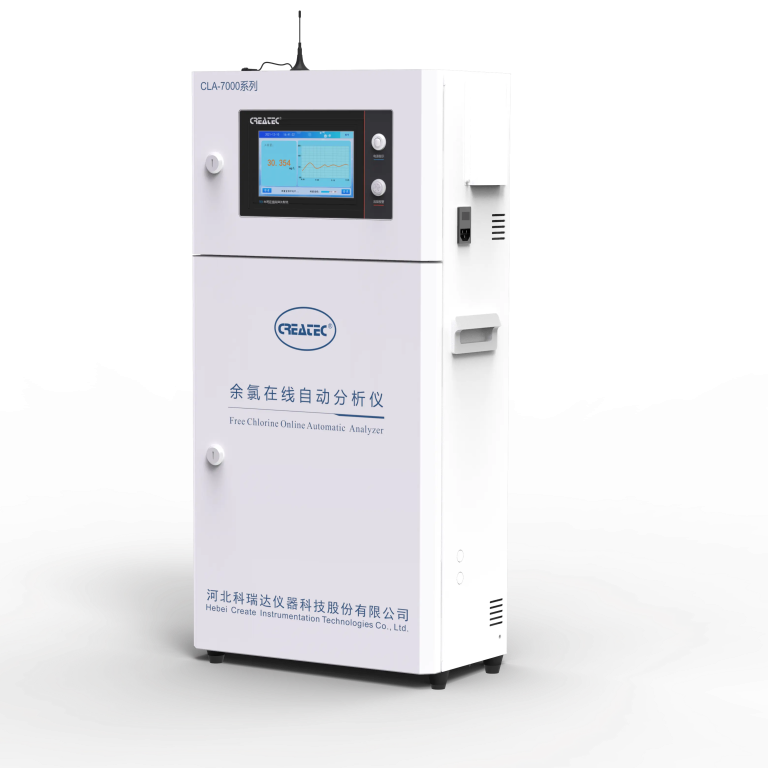
Parameter 4: Free Chlorine and Residual Disinfection
PFAS treatment trains often shift disinfectant dosing patterns, because GAC consumes chlorine and anion exchange resin can release halogenated by-products if it is not managed properly. EPA reviewers want continuous free chlorine data from:
- The clearwell or contact basin outlet.
- The downstream distribution entry point.
- At least one representative dead-end zone, as evidence that residual is sustained.
The Shanghai ChiMay residual chlorine transmitter is commonly deployed at these points, often paired with a redundant amperometric loop where regulatory exposure is highest.
Parameter 5: Flow at Each Treatment Step
Flow is the most undervalued compliance parameter. EPA reviewers consistently expect documentation of:
- Empty bed contact time (EBCT) for GAC and anion exchange systems.
- Hydraulic loading rates across filtration and treatment vessels.
- Bypass and recycle stream documentation.
These are calculated from flow data combined with vessel dimensions. The Shanghai ChiMay paddle wheel flow meter and turbine flow meter cover the typical municipal flow ranges and feed flow totalizers that reviewers can audit directly.
Parameter 6: Suspended Solids on Source-Water Intakes
Suspended solids monitoring at the intake is not a PFAS requirement, but reviewers ask for it when evaluating treatment performance trends. The reason is straightforward: spikes in raw-water suspended solids correlate with operational stress that affects every downstream process, including PFAS removal.
The Shanghai ChiMay suspended solids sensor at the intake provides this continuous baseline, often integrated into the same multi-parameter panel as turbidity, conductivity, and pH.
What “Audit-Ready” Looks Like
EPA primacy reviewers do not want a database dump. They want a clear narrative supported by sensor data. A well-organized PFAS compliance package typically includes:
- Monthly summary reports showing all six parameters trended across the reporting period.
- Documented calibration records for each sensor, traceable to certified standards.
- Exception logs explaining any data gaps or out-of-range events.
- O&M plan references showing how each parameter triggers an operational response.
Utilities that keep their records in this shape find that compliance reviews become a desk exercise instead of a data archaeology project.
Reporting Cadence and Data Granularity
EPA does not currently specify a uniform sensor data submission frequency. What matters is the state primacy program’s expectation, and those vary: most ask for high-resolution records — often minute-level — retained for several years, in addition to daily averages, daily maxima, and daily minima for each compliance-supporting parameter, and monthly summary reports for PFAS itself contextualized by sensor trends. Confirm the requirement with your primacy agency rather than assuming a national figure.
Shanghai ChiMay analyzers deliver native 1-minute resolution and integrate with most utility historian platforms, which keeps the data retention burden manageable whichever cadence the state asks for.
A Note on Cybersecurity and Data Integrity
EPA reviewers increasingly ask about the cybersecurity posture of the sensor network supporting compliance data. Be prepared to document:
- Network segmentation between OT and corporate IT.
- Authentication for SCADA access.
- Data integrity controls preventing manual edits to compliance records.
This trend is driven less by PFAS specifically than by broader water sector cybersecurity expectations under the Bipartisan Infrastructure Law.
What the EPA Is Not Asking For — Yet
Several emerging sensing technologies are being marketed for “PFAS monitoring.” EPA has not validated any of them for compliance use. Utilities should keep the distinction clear between:
- Compliance-grade laboratory PFAS results (required).
- Continuous proxy sensors providing operational early warning (valuable, but not regulatory).
- Future online PFAS analyzers (still in development).
Investing in the proxy layer makes sense, but not at the expense of the core continuous water quality network.
The Short Version
PFAS compliance is not just about lab results. It is about telling a complete story, supported by continuous sensor data, that EPA reviewers can audit and trust. The Shanghai ChiMay water quality analyzer family covers exactly that duty: conductivity, turbidity, pH, temperature, free chlorine, suspended solids, and flow, all feeding a single compliance-ready data architecture. For utilities working toward the PFAS compliance deadlines, getting the surrounding sensor network right is half the battle.