Table of Contents
Introduction
Selecting water quality sensors for desalination applications requires balancing measurement accuracy, environmental durability, maintenance requirements, and total cost of ownership. The consequences of poor sensor selection extend far beyond purchase prices: inappropriate sensors increase operational costs, accelerate membrane damage, and generate unreliable data that undermines process control. Sensor spend is a rounding error against plant operating cost, but the data those sensors generate steers nearly everything else the plant does. This guide provides a systematic framework for making informed selection decisions.
The stakes are large in absolute terms. Global desalination capacity continues to grow, with the market worth tens of billions of dollars annually and reverse osmosis accounting for roughly two-thirds or more of installed capacity worldwide. Every one of those plants runs on sensor data.
Understanding Your Monitoring Requirements
Process Parameters to Monitor
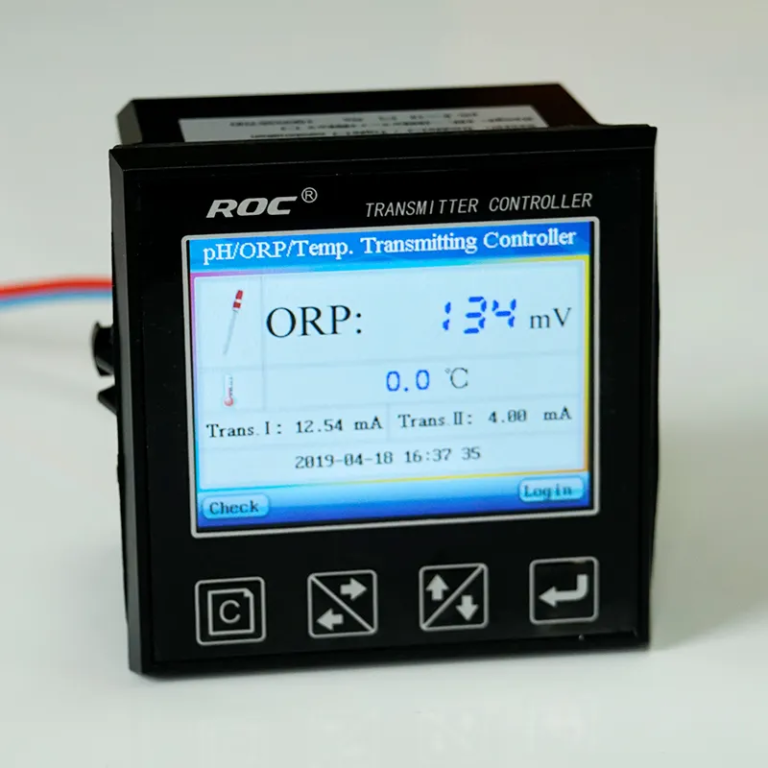
Begin by clearly defining monitoring needs. Determine what parameters require measurement: conductivity is essential for all desalination applications; pH is required for scaling control; turbidity is critical for pretreatment monitoring; pressure is essential for membrane protection; chlorine/ORP is for biofouling control; dissolved oxygen for specific process requirements.
Determine where measurements are needed: intake water characterization, pretreatment outlets, membrane feed and concentrate, product water quality, and cleanup systems.
Determine what measurement ranges are expected: conductivity from 50 mS/cm (seawater) to 500 μS/cm (product), pH typically 6.5-8.5 with excursions to 5.5-10, turbidity from 0.1 NTU (product) to 100+ NTU (feed water).
Consequence Analysis
Not all measurement errors have equal consequences. Critical measurements with high consequences of error include product water quality for regulatory compliance, membrane protection for expensive equipment damage, and safety-related parameters.
Important measurements with moderate consequences include optimization parameters for economic efficiency and trend monitoring for predictive maintenance.
Support measurements with lower consequences include general information gathering and research or development activities.
Allocate your sensor budget so critical measurements get the highest-quality instruments.
Technical Selection Criteria
Accuracy Specifications
Accuracy requirements depend on the measurement application. For membrane performance monitoring: conductivity requires ±1% of reading or better; pH requires ±0.1 units or better; pressure requires ±0.5% of full scale or better.
For process optimization: conductivity requires ±2% of reading typically acceptable; pH requires ±0.2 units often sufficient; turbidity requires ±5% of reading or better.
For alarm and shutdown functions: accuracy may be less important than repeatability; consider deadband and delay specifications.
Avoid specifying accuracy tighter than your application requires—higher accuracy typically increases sensor cost and maintenance requirements.
Range and Span Considerations
Sensor selection must accommodate expected measurement ranges. Single-range sensors are simpler and less expensive, suitable when ranges are predictable. Multi-range sensors accommodate varying conditions, useful for intake monitoring where quality varies seasonally. Auto-ranging instruments automatically adjust range for varying inputs, suitable for applications with wide measurement variation.
Fouling Resistance
Marine environments demand fouling-resistant designs. Sensor body materials should include titanium, Hastelloy, and certain plastics that resist seawater corrosion better than stainless steel. Reference junction designs—flowing junctions, open junctions, and capillary junctions—each address fouling differently based on expected biological activity.
Shanghai ChiMay engineers sensors specifically for marine fouling resistance, incorporating designs developed through years of desalination experience.
Installation Considerations
Mounting Configurations
Sensor mounting affects measurement reliability and maintenance access. Inline installation has the sensor inserting directly into process piping—compact, representative sampling, but requires process shutdown for maintenance. Flow-through cells have sample flowing through a dedicated chamber—easier maintenance, requires a representative sampling line. Submersible installation has the sensor hanging below the water surface—suitable for tanks and open channels. Retractable assemblies allow insertion and removal without process shutdown—higher cost but enables maintenance without production interruption.
Process Connection Standards
Standardize process connections across your sensor network. Threaded connections are common for small sensors with various standards (NPT, BSP, ISO). Flanged connections are standard for large sensors and corrosive service. Sanitary connections—tri-clamp and similar—for hygienic applications.
Communication and Integration
Signal Types
Modern sensors offer various output options. Analog outputs (4-20 mA) are industry standard and widely compatible with long transmission distances, but carry limited data bandwidth for a single measurement value. Digital protocols (HART, Modbus, Foundation Fieldbus) provide multiple values per sensor plus diagnostic information, but require more complex integration. Wireless options reduce installation costs but require network infrastructure.
Control System Compatibility
Verify sensor communication protocols match your control system capabilities. Consider PLC/DCS input card compatibility, protocol implementation differences, master/slave configuration requirements, and data update rates and latency requirements.
Shanghai ChiMay sensors support multiple communication options, enabling integration with virtually any control system architecture.
Total Cost of Ownership
Initial Versus Lifecycle Costs
Sensor selection should consider total lifecycle costs. Initial purchase price is often the smallest component of total cost. Installation costs include wiring, conduit, mounting hardware, and commissioning. Maintenance costs include calibration, cleaning, replacement parts, and labor. Calibration standards are consumables required for calibration. Downtime costs include lost production when sensors fail or require maintenance.
Calculate total cost over expected sensor life (typically 3-5 years for quality marine sensors) to compare options fairly.
Maintenance Requirements
Different sensor technologies require different maintenance intensities. Traditional sensors may require weekly or monthly calibration. Self-calibrating sensors extend intervals to quarterly or longer. Smart sensors store calibration data, reducing documentation burden.
Select sensors with maintenance requirements matching your maintenance capabilities—if weekly calibration isn’t feasible, select sensors that don’t require it.
Supplier Evaluation
Technical Capabilities
Evaluate suppliers based on product range for comprehensive product lines enabling single-source purchasing, marine application experience for desalination-specific expertise, quality certifications like ISO 9001, and warranty terms demonstrating manufacturer confidence.
Support Services
Technical support quality significantly impacts sensor performance. Application engineering provides assistance selecting appropriate sensors for specific requirements. Installation support provides commissioning assistance ensuring proper installation. Training programs help maintenance staff maximize sensor performance. Service capabilities include repair services, calibration services, and emergency support availability.
Shanghai ChiMay provides comprehensive support services including application engineering, installation assistance, and ongoing technical support.
Making the Final Decision
Evaluation Matrix
Systematically compare options across accuracy (25% weight), fouling resistance (20%), initial cost (15%), maintenance cost (15%), supplier support (15%), and warranty (10%). Adjust weights based on your specific priorities.
Pilot Testing
Consider pilot testing sensors in critical applications: short-term evaluation of measurement reliability, assessment of fouling behavior in your specific water, verification of integration with control systems, and feedback from operators who will use the sensors daily.
Conclusion
Sensor selection significantly impacts desalination plant performance—affecting membrane life, operational costs, and water quality reliability. Successful selection requires systematic evaluation of technical requirements, environmental challenges, and lifecycle costs.
Shanghai ChiMay’s application engineering team helps customers navigate sensor selection, providing expertise developed through years of desalination experience. By carefully evaluating requirements and selecting appropriate sensors, desalination operators can achieve reliable monitoring that supports efficient, cost-effective operation.