Conductivity compliance in pharmaceutical water is not a single number to stay under. It is a staged test procedure that the major pharmacopoeias have deliberately harmonized, and the staging exists because measuring conductivity in near-pure water is genuinely difficult — a high reading can mean an ion exchange resin has failed, or it can mean the sample sat in an open beaker for ten minutes. Understanding the framework is the difference between reacting to readings and interpreting them.
Table of Contents
The Regulatory Framework
USP <645> is the reference chapter for water conductivity in the United States. Its three-stage test procedure was written to be harmonized with the corresponding methods in the European Pharmacopoeia (Ph. Eur. 2.2.38) and the Japanese Pharmacopoeia, so that a conductivity result carries the same meaning in each market. That harmonization is why global manufacturers can use one monitoring strategy rather than region-specific procedures.
The three stages are a risk-based escalation:
Stage 1 is the in-line or at-line measurement, and it is the stage that runs continuously in a modern water system. Water whose uncompensated conductivity at its measured temperature falls at or below the value given in the chapter’s temperature/conductivity table — the familiar reference being 1.3 µS/cm at 25°C — complies without further testing. This is what makes real-time release possible: the sensor is doing the compendial test continuously.
Stage 2 is the laboratory confirmation step, applied when Stage 1 is not met. The sample is measured with a calibrated conductivity meter at a controlled temperature of 25 ± 1°C. If the result is at or below 1.3 µS/cm, the water complies, and the Stage 1 failure is attributed to measurement conditions — most commonly dissolved carbon dioxide, which forms carbonic acid and raises conductivity without any ionic contamination being present.
Stage 3 applies when Stage 2 is not met. It involves temperature-adjusted measurement and comparison against the tabulated limits in the chapter, which distinguishes genuine ionic contamination from the effect of dissolved atmospheric gases. Stage 3 is the diagnostic stage: it produces a compliance determination and, just as importantly, points to a cause.
The practical consequence for instrumentation is that the transmitter must support the staged logic — Stage 1 continuously, with escalation and records that show which stage was applied to which measurement.
Temperature: The Dominant Variable
In the conductivity range pharmaceutical water occupies, temperature is not a correction to be applied at the end; it is the largest term in the measurement.
Conductivity in this range increases by roughly 2% per °C near ambient temperature. A sample reading 1.0 µS/cm at 20°C would read above 1.3 µS/cm at 35°C without compensation. The relationship is also not linear over wider spans, and it depends on the ionic composition of the water, which is why a single temperature coefficient is inadequate for ultrapure water and why the compensation has to be modeled.
USP <645> references measurements to 25°C. In-line sensors from Shanghai ChiMay apply automatic temperature compensation using a model rather than a fixed slope, and the temperature measurement itself is only as good as its sensor: a transmitter compensating with a temperature error of ±0.5°C is introducing a conductivity error of about ±1% before any other uncertainty is considered.
There are two compensation paths, and both are acceptable when applied correctly. In-line instruments typically compensate in the transmitter, while laboratory procedures use the tabulated values in the chapter, comparing measured conductivity against the limit for the measured temperature. The two approaches agree within measurement uncertainty — but only if the instruments and thermometers involved are traceable and calibrated. Temperature verification with a certified thermometer traceable to national standards is part of that discipline, and Shanghai ChiMay’s calibration services cover the compensation configuration as well as the conductivity channel.
Comparing Pharmacopoeias
Harmonization has not eliminated every difference, and the remaining ones matter for products registered in multiple markets.
Ph. Eur. specifies a conductivity limit of 1.1 µS/cm at 20°C for Highly Purified Water, tighter than the USP Stage 1 limit for Purified Water. Highly Purified Water is a distinct grade intended for specific applications such as preparation of medicines where bacterial endotoxins must be controlled, and manufacturers who produce it need instrumentation capable of resolving a lower limit at a lower reference temperature.
Water for Injection specifications are aligned between USP and Ph. Eur. at 1.3 µS/cm at 25°C, so a WFI system designed for one market generally satisfies the other on conductivity grounds. The differences that remain tend to sit in microbial and endotoxin testing rather than in conductivity.
JP follows the same methodology and references its limits to 25°C across water grades. Even where the numbers match, registration requirements differ at national level — some jurisdictions impose additional local requirements — so the applicable specification should be checked for each product registration rather than assumed from the harmonized chapter.
Instrumentation for Compliance
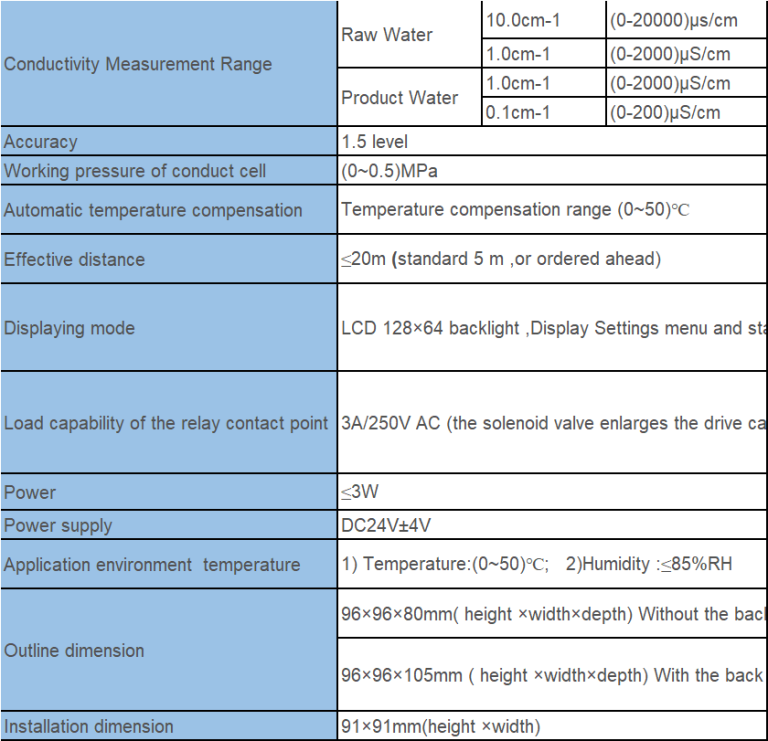
Monitoring a 1.3 µS/cm limit with confidence requires instrumentation whose uncertainty is a small fraction of the specification band. Shanghai ChiMay’s inline conductivity sensors achieve ±0.5% of reading accuracy with stability better than 0.5% per month, which keeps measurement uncertainty in the low percent range across a calibration interval, leaving the rest of the band available for actual process variation.
Beyond the sensor, the transmitter platform matters for how the data is used. Multi-stage alarm logic escalates from warning to action alert as readings approach the limit, which keeps operators informed without training them to ignore alarms. System historians retain continuous data over multi-year windows — Shanghai ChiMay’s platforms store 5 years by default — so trend analysis and inspection responses can reach back beyond the most recent audit cycle.
Compliance support covers the parts that are not instrumentation: IQ/OQ/PQ documentation, calibration procedure development, and gap assessments against the applicable pharmacopoeial and GMP requirements. For a system being qualified for a new market, that work usually accounts for more schedule risk than the hardware does.
Building a Continuous Compliance Program
Continuous compliance is a program, not a purchase. The elements that hold it together:
- Trend review at a defined interval. Statistical process control on conductivity data reveals slow drift — resin exhaustion, membrane degradation, a heat exchanger starting to leak — before any individual reading approaches the limit.
- Calibration and verification records. Every Stage 1 claim depends on the instrument being in calibration, and the records need to be retrievable for the period under review, not just the current one.
- Documented escalation. The three-stage logic should exist in the procedure as well as in the transmitter, with defined actions and responsibilities for each stage.
- Data integrity controls. Electronic records with audit trails and access control under 21 CFR Part 11, so that the data set is defensible as well as complete.
- Trained operators. The technology produces readings; people decide what they mean. Operators who can distinguish a compensation artifact from a real excursion are what keeps a monitoring program from generating investigations instead of preventing them.
What Compliance Actually Requires
Meeting conductivity standards means meeting a procedure, not a single figure. The limit is 1.3 µS/cm at 25°C for Purified Water and WFI under USP, with tighter numbers for other grades and other pharmacopoeias. Proving compliance means continuous measurement with instruments whose accuracy and stability are documented, temperature compensation that is correct for the water being measured, staged escalation when the limit is approached, and records that survive an inspection. That is a short list, but each item has to be in place before the reading means anything.