Table of Contents
Introduction: The Challenge of Water Quality in Controlled Environments
Greenhouse and controlled environment agriculture (CEA) operations achieve yields several times higher than field production—commercial tomato greenhouses routinely harvest multiples of what the same footprint produces outdoors—but this productivity depends on holding water quality within tight bands. Unlike field crops that can draw on soil water reserves and natural nutrient cycling, greenhouse plants depend entirely on the irrigation solution provided, making water quality management a fundamental determinant of success.
Growing experience across the CEA sector identifies water quality parameters as a leading factor affecting crop performance in greenhouse systems:
– pH imbalances drive a large share of nutrient deficiency symptoms
– Electrical conductivity errors cause most osmotic stress events
– Dissolved oxygen depletion contributes to root disease outbreaks
– Temperature extremes amplify every other stress factor
Traditional greenhouse water quality management relies on periodic manual testing—typically checking pH and EC 2-4 times daily with handheld meters. This approach misses the fluctuations that occur between measurements, and it leads to a familiar failure pattern: crop stress develops gradually until visible symptoms trigger corrective action, often too late to prevent yield loss.
Shanghai ChiMay 4-in-1 multi-parameter sensors provide continuous monitoring of all critical water quality parameters, moving greenhouse management from reactive problem-solving to proactive control.
Understanding Multi-Parameter Interactions
The Chemistry of Greenhouse Irrigation
Greenhouse irrigation solutions involve four primary parameters that influence each other continuously:
Parameter Interactions:
1. pH affects nutrient availability: Each essential nutrient has specific pH ranges for optimal uptake
2. EC indicates total concentration: Changes with both nutrient depletion and water evaporation
3. DO affects root health: Low oxygen causes root death and favors Pythium and Phytophthora
4. Temperature compounds everything: Affects pH stability, EC readings, DO solubility, and plant metabolic rates simultaneously
A Critical Interdependency:
When pH drifts upward above 7.0:
– Iron becomes unavailable despite adequate concentration
– Phosphorus availability drops sharply
– Manganese uptake slows, causing chlorosis
– Plants look nutrient-deficient, but adding fertilizer makes the problem worse
This cascading effect is why single-parameter monitoring fails—correcting pH without watching EC and DO dynamics often creates new problems.
Optimal Parameter Ranges by Crop Type
Target Ranges for Major Greenhouse Crops:
| Crop Category | pH | EC (mS/cm) | DO (mg/L) | Temperature (°C) |
|---|---|---|---|---|
| Tomatoes | 5.8-6.2 | 1.5-3.0 | 4.0-8.0 | 18-24 |
| Cucumbers | 5.5-6.0 | 1.8-2.5 | 4.0-8.0 | 20-26 |
| Peppers | 5.5-6.5 | 1.5-2.5 | 4.0-8.0 | 20-26 |
| Lettuce | 5.5-6.5 | 0.8-1.8 | 4.0-8.0 | 15-22 |
| Strawberries | 5.5-6.5 | 1.2-1.8 | 4.0-8.0 | 16-24 |
| Ornamentals | 5.5-6.5 | 1.0-3.0 | 4.0-8.0 | 18-25 |
Seasonal Adjustment Requirements:
– Summer: Higher DO needs, lower target EC (increased evapotranspiration)
– Winter: Lower DO acceptable, higher target EC (reduced water uptake)
– Propagation: Lower EC for cuttings, higher DO for root development
Shanghai ChiMay Multi-Parameter Sensor Technology
Integrated Measurement Platform
Shanghai ChiMay 4-in-1 multi-parameter sensors combine all essential measurements in a single probe:
Technical Specifications:
| Parameter | Range | Accuracy | Response Time |
|---|---|---|---|
| pH | 0-14 | ±0.02 | <10 seconds |
| EC | 0-20 mS/cm | ±0.5% reading | <5 seconds |
| DO | 0-20 mg/L | ±1% reading | <30 seconds |
| Temperature | 0-80°C | ±0.1°C | Real-time |
Single Probe Advantages:
– One calibration procedure for all parameters
– One mounting point in reservoir or NFT channel
– Single data cable to controller
– One maintenance routine for all sensors
– Co-located measurement ensures parameter correlation is meaningful
Installation Configurations
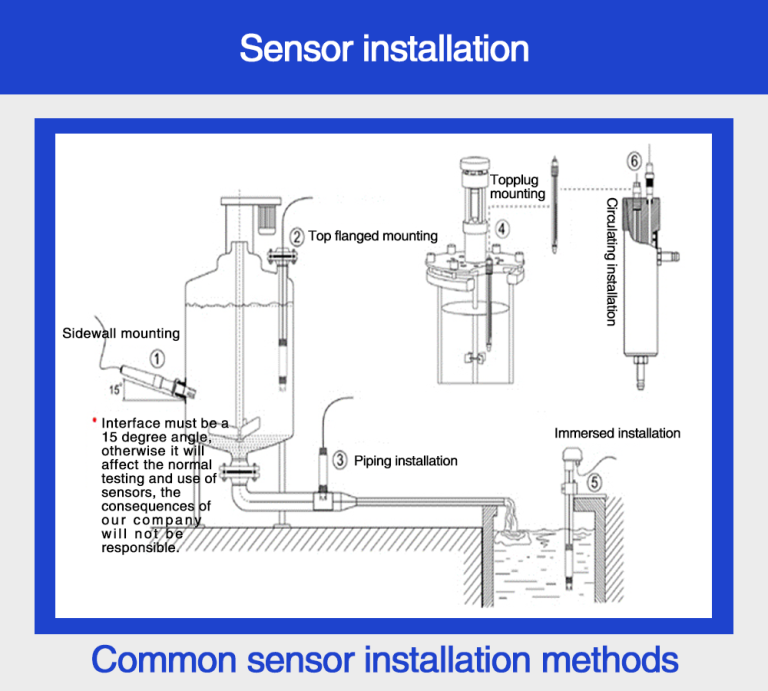
Effective deployment requires matching sensor placement to system architecture:
NFT (Nutrient Film Technique) Systems:
– Primary sensor: Supply manifold before NFT channels
– Secondary sensors: One per 50-100 meters of channel length
– Drain sensor: Verify solution quality returning to reservoir
DWC (Deep Water Culture) / Raft Systems:
– Root zone sensors: Suspended in raft channels
– Reservoir sensors: Monitor bulk solution quality
– Channel sensors: Detect temperature stratification
Drip Irrigation Systems:
– Irrigation line sensors: Monitor solution before delivery
– Container drainage sensors: Verify percolate quality
– Reservoir sensors: Track bulk solution changes
Propagation Benches:
– High-frequency monitoring during critical root development
– Lower EC requirements for cutting establishment
– Enhanced DO for root zone oxygenation
Quantifying Multi-Parameter Management Benefits
Yield and Quality Improvements
Growers and research stations that have compared single-parameter versus multi-parameter management report the same pattern: holding pH alone is not enough. Trials on high-wire tomatoes in NFT systems under multi-parameter monitoring and automated control have shown double-digit yield gains over pH-only management, with the biggest differences appearing during the mid-season period when rootzone chemistry drifts fastest.
The economics follow the yield. Additional saleable production, plus savings in water, nutrients, and energy, add up to a meaningful per-square-meter advantage for continuously monitored systems—large enough that sensor hardware pays for itself within a single season in most commercial operations.
Operational Efficiency Gains
Multi-parameter monitoring reduces management load substantially:
Automated systems with continuous monitoring cut the daily manual checking routine to a verification step. Labor time once spent walking benches with handheld meters goes into crop work instead, and large commercial operations report annual labor savings of several thousand dollars per 1,000 m² of growing area.
Automated Control Integration
Dosing Control Logic
Continuous monitoring enables fully automated nutrient management:
Control Algorithm Framework:
// pH Control
IF pH < target_low:
    ADD pH-down solution (acid) at proportional rate
IF pH > target_high:
    ADD pH-up solution (base) at proportional rate

// EC/Nutrient Control
IF EC < target_low:
    INCREASE nutrient concentrate flow rate
IF EC > target_high:
    DILUTE with fresh water or reduce concentrate

// Temperature Control
IF solution_temp > max_threshold:
    ACTIVATE reservoir cooling (chiller or heat exchange)
IF solution_temp < min_threshold:
    ACTIVATE reservoir heating

// DO Management
IF DO < minimum_threshold:
    ACTIVATE air pump or oxygenation system
IF DO > maximum_threshold:
    REDUCE aeration (prevents excessive gas stripping)
Closed-loop systems hold parameters near target continuously without manual intervention.
Alert and Response Systems
Real-time alerts prevent problems before crop impact. Sensible configurations separate alert tiers—informational drift, actionable excursions, and critical alarms that page a human—so that operators respond to real problems instead of tuning out noise.
Maintenance Best Practices
Sensor Care Protocols
Proper maintenance keeps long-term accuracy:
Weekly Tasks:
– Visual inspection for algae or debris on sensor surfaces
– Verify flow past sensors (stagnation causes measurement errors)
– Check cable connections for corrosion or damage
– Review data logs for anomalous readings
Monthly Maintenance:
– pH electrode cleaning (soft brush, no abrasives)
– EC sensor verification (calibration standard check)
– DO sensor cap inspection (replace if scratched or discolored)
– Temperature probe verification
Calibration: Establish a fixed schedule based on the manufacturer’s guidance and observed drift; log every calibration against reference standards so drift trends become visible.
Conclusion: Simplifying Complexity Through Integration
Multi-parameter monitoring turns greenhouse management from overwhelming complexity into manageable automation—enabling operations to scale without proportional increases in labor or expertise.
Shanghai ChiMay 4-in-1 sensors give greenhouse operations:
– Complete parameter coverage in a single integrated probe
– Automated control integration for dosing and climate systems
– Real-time alerts that catch problems before visible symptoms
– Data logging for historical analysis and optimization
– Simplified maintenance through unified sensor care
For greenhouse producers scaling production while holding quality, multi-parameter monitoring is the technological foundation that makes sustainable growth possible.
Shanghai ChiMay offers multi-parameter monitoring solutions for greenhouse and controlled environment agriculture, including integrated sensor systems, automated dosing controllers, and cloud-based management platforms.