Key Takeaways:
– The membrane water and wastewater treatment market is growing steadily — Mordor Intelligence estimates about USD 6.9 billion in 2026, rising to USD 9.8 billion by 2031 (~7.2% CAGR); broader market definitions that include all water-treatment membrane products place the value higher (roughly USD 25 billion by 2025 in wide-scope estimates).
– Covalent organic framework (COF) membranes show extraordinary lab-scale potential: a 2025 Journal of the American Chemical Society study reported 99.7% NaCl rejection, and a Nature Water 2025 study demonstrated >99% salt rejection via low-temperature pervaporation — but commercial products remain years away.
– Metal-organic framework (MOF) mixed-matrix membranes and 2D materials (graphene oxide, MXene, MoS₂) continue advancing in peer-reviewed research, with permeability/selectivity trade-offs improving rather than any single universal percentage gain.
– Energy recovery devices already cut seawater RO energy use dramatically — isobaric pressure exchangers reach 97%+ transfer efficiency, bringing modern SWRO plants toward ~2 kWh/m³.
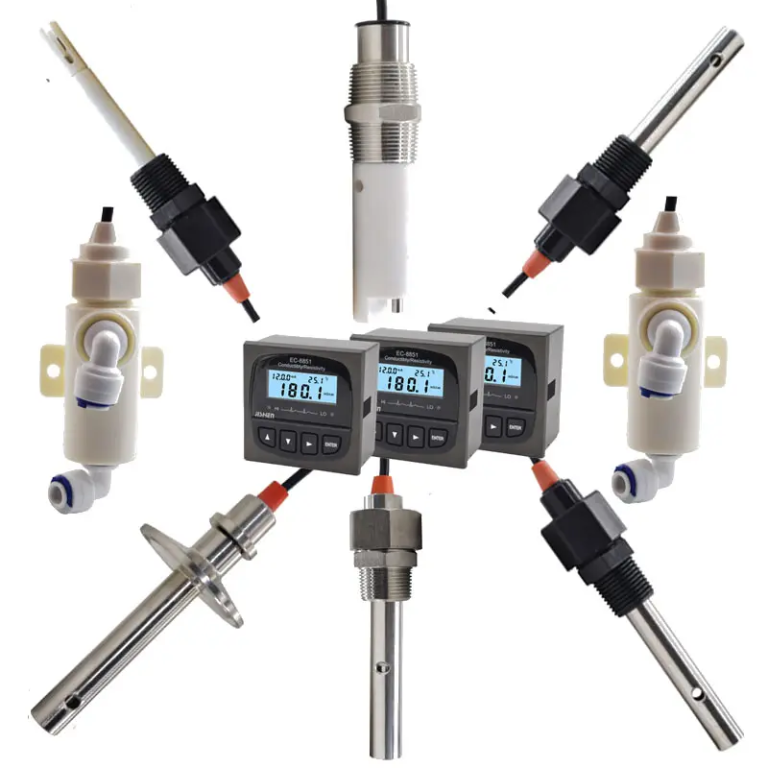
– Shanghai ChiMay online analyzers provide the turbidity, conductivity, and multi-parameter monitoring that next-generation membrane systems depend on.
Table of Contents
Introduction
Membrane technology stands at an inflection point. Conventional polyamide thin-film composite membranes have matured, while demand for water reuse, desalination, and ultrapure water keeps rising. Advanced materials science, artificial intelligence, and modular design are opening a new wave of innovation. This article surveys where the technology genuinely stands — separating published research results from commercial reality.
Advanced Materials
Covalent Organic Frameworks (COFs)
COFs are crystalline porous polymers built from organic building blocks linked by strong covalent bonds, offering ordered, tunable pore channels at the angstrom scale. They are among the most actively studied membrane materials, but performance claims deserve careful reading.
What peer-reviewed research actually shows:
- Pressure-driven desalination: A December 2025 JACS study (Zhengzhou University / Rice University) reported acid-modulated interfacial synthesis producing an ultramicroporous COF membrane with a record 99.7% NaCl rejection and water permeance of 0.82 L m⁻² h⁻¹ bar⁻¹ — high selectivity, though at permeance levels typical of tight membranes rather than order-of-magnitude gains JACS.
- Pervaporation desalination: A Nature Water 2025 study used photo-responsive COF membranes to achieve >99% salt rejection at 30 °C under solar-vacuum driving, with water flux up to 120 kg m⁻² h⁻¹ Nature Water.
- Rapid synthesis: NYU Abu Dhabi researchers demonstrated microwave-assisted synthesis of self-standing COF membranes in minutes rather than days, with superhydrophilic surfaces achieving complete oil removal and high dye rejection in filtration — demonstrated for oil/water and dye separations, not desalination JACS Au / NYUAD.
- Scale-up progress: A 2025 Angewandte Chemie study demonstrated solvation-mediated assembly of self-standing COF membranes at roughly 2,400 cm² scale with strong mechanical properties, pointing toward manufacturability.
COF membranes are generally assessed at TRL 4–6 (lab to pilot). Claims of imminent commercial desalination products should be treated cautiously; scale-up, defect control, and long-term fouling data remain open questions.
Metal-Organic Frameworks (MOFs)
MOF mixed-matrix membranes embed crystalline MOF nanoparticles in polymer matrices. Reviews consistently report that well-dispersed MOF fillers can improve permeability and/or selectivity over the neat polymer — particularly for gas separation and selected liquid separations — but improvements are highly system-specific: a blanket “30–50% performance gain” across water treatment is not supported by the literature. MOF-based water treatment membranes remain largely in development and early commercial trials, with cost and filler–matrix compatibility as limiting factors.
Other Mixed-Matrix and 2D Materials
- Graphene oxide membranes demonstrate ion-sieving through tunable interlayer spacing in laboratory studies; scalable defect-free fabrication remains the central challenge.
- MXene and MoS₂ membranes offer high flux and chemical stability in research settings.
- Nanoparticle fillers (TiO₂, silica, carbon nanotubes) improve hydrophilicity and fouling resistance in commercial membrane modifications already on the market.
Surface Modification Technologies
Zwitterionic polymer brushes create tightly bound hydration layers that strongly resist protein and organic adsorption — one of the most validated anti-fouling surface chemistries, used increasingly in biomedical and high-purity applications.
Photocatalytic surfaces (notably TiO₂) generate reactive oxygen species under UV/visible light, degrading organic foulants; TiO₂ is widely permitted for food-contact applications, and LED light sources are lowering implementation barriers.
Stimuli-responsive and self-healing coatings — temperature- or pH-responsive polymers, microcapsule-based healing agents — remain largely in research, with field-proven membrane products still limited.
Process Intensification and Energy
Energy recovery is the clearest commercial success story. Isobaric rotary pressure exchangers transfer pressure from brine reject to incoming feed at 97%+ efficiency (with the latest generation approaching 98–99%), cutting SWRO energy consumption from roughly 6 kWh/m³ without recovery toward 2.5–3.0 kWh/m³ in well-equipped plants, with best-in-class large facilities approaching ~2 kWh/m³ Energy Recovery. Forward osmosis and hybrid FO-RO configurations can reduce energy further in specific applications.
Modular, containerized, and skid-mounted membrane systems are commercially available today, enabling decentralized treatment, rapid deployment for emergency response, and remote community water supply.
Digital Transformation
AI and machine learning are being applied to fouling prediction, cleaning optimization, membrane lifetime forecasting, and anomaly detection. Peer-reviewed studies demonstrate meaningful energy and chemical savings at pilot and full scale, though results vary with data quality and sensor coverage. Major water technology suppliers market AI-enabled optimization platforms (often rebranded over time), and digital twins are increasingly used for operator training and scenario testing — adoption rates are growing from a small base rather than dominating new builds.
Continuous sensor data is the prerequisite for all of it. Shanghai ChiMay provides:
– Online turbidity analyzers for fouling detection and feedwater control
– Conductivity meters for permeate quality and membrane integrity verification
– Multi-parameter sensors (pH, ORP, conductivity, temperature) for process optimization
– Residual chlorine analyzers to protect polyamide membranes from oxidation
Sustainability and Resource Recovery
Membrane systems underpin circular-economy water strategies: industrial reuse facilities routinely target 80–95% water recovery in well-designed ZLD/MLD configurations, and the EU Water Reuse Regulation (2020/741) sets minimum requirements for agricultural reuse. Resource recovery — phosphorus, nitrogen, and increasingly salinity-gradient energy via pressure-retarded osmosis — is maturing at varying paces.
Technology Readiness Snapshot
| Technology | Maturity | Status |
|---|---|---|
| Conventional RO/UF/NF | TRL 9 | Mass market |
| Ceramic membranes | TRL 8–9 | Commercial |
| Isobaric energy recovery | TRL 9 | Standard in large SWRO |
| AI-optimized operation | TRL 7–8 | Early commercial adoption |
| MOF mixed-matrix (water) | TRL 4–6 | Pilot/early trial |
| COF membranes | TRL 4–6 | Lab to pilot |
| Self-healing membranes | TRL 3–5 | Research |
| Aquaporin/bio-inspired membranes | TRL 5–7 | Niche commercial products |
Aquaporin-incorporated membranes, which embed biological water-channel proteins into polymer films, are the most commercially advanced bio-inspired approach, with products in niche industrial and space applications; performance advantages over best-in-class conventional membranes remain application-dependent.
Conclusion
The membrane field’s genuine frontier is exciting enough without inflated numbers: COF membranes achieving 99.7% salt rejection in published research, MOF and 2D-material composites pushing the permeability-selectivity boundary, pressure exchangers driving desalination energy toward thermodynamic practicality, and AI converting sensor data into operational savings. Shanghai ChiMay online analyzers supply the measurement foundation these systems require — because every advanced membrane process is only as well controlled as the data feeding it.
Sources
- Yuan et al., “Precision-Engineered Crystalline COF Membranes…”, J. Am. Chem. Soc. 2025 — https://pubs.acs.org/doi/10.1021/jacs.5c16195
- Jiang et al., “Ultrafast low-temperature pervaporation desalination with photo-responsive COF membranes”, Nature Water 2025 — https://doi.org/10.1038/s44221-025-00538-0
- NYU Abu Dhabi, “Tunable Wettability of a Dual-Faced COF Membrane…”, JACS Au 2024 — https://pmc.ncbi.nlm.nih.gov/articles/PMC11345768/
- Mordor Intelligence, Membrane Water and Wastewater Treatment Market — https://www.mordorintelligence.com/industry-reports/membrane-water-and-wastewater-treatment-wwt-market
- Energy Recovery Inc., PX Pressure Exchanger technology — https://energyrecovery.com/pressure-exchangers/high-pressure-px/
- EU Water Reuse Regulation (EU) 2020/741 — https://eur-lex.europa.eu/eli/reg/2020/741/oj