title: “Plug-and-Play Wiring Standards That Cut Sensor Commissioning to Hours: A Shanghai ChiMay Field Playbook”
date: 2026-07-15
perspective: Technical Deep-Dive
theme: Modular & Decentralized Treatment Deployments
Table of Contents
Plug-and-Play Wiring Standards That Cut Sensor Commissioning to Hours: A Shanghai ChiMay Field Playbook
The short version
- Analyzer commissioning on a conventional modular skid still takes 6-12 site-hours per sensor when custom wiring is used; skids built around M12 A-coded connectors and standardized cordsets consistently deliver 1-2 site-hours per sensor.
- Wiring errors are the leading root cause of first-day commissioning failure on decentralized plants, accounting for 40-55% of documented issues in 2026 field surveys — well ahead of sensor calibration or firmware problems.
- A plug-and-play wiring standard is more than the connector itself; it’s a stack that also includes pin assignments, cable shielding rules, torque specifications, and clear color coding across the whole analyzer fleet.
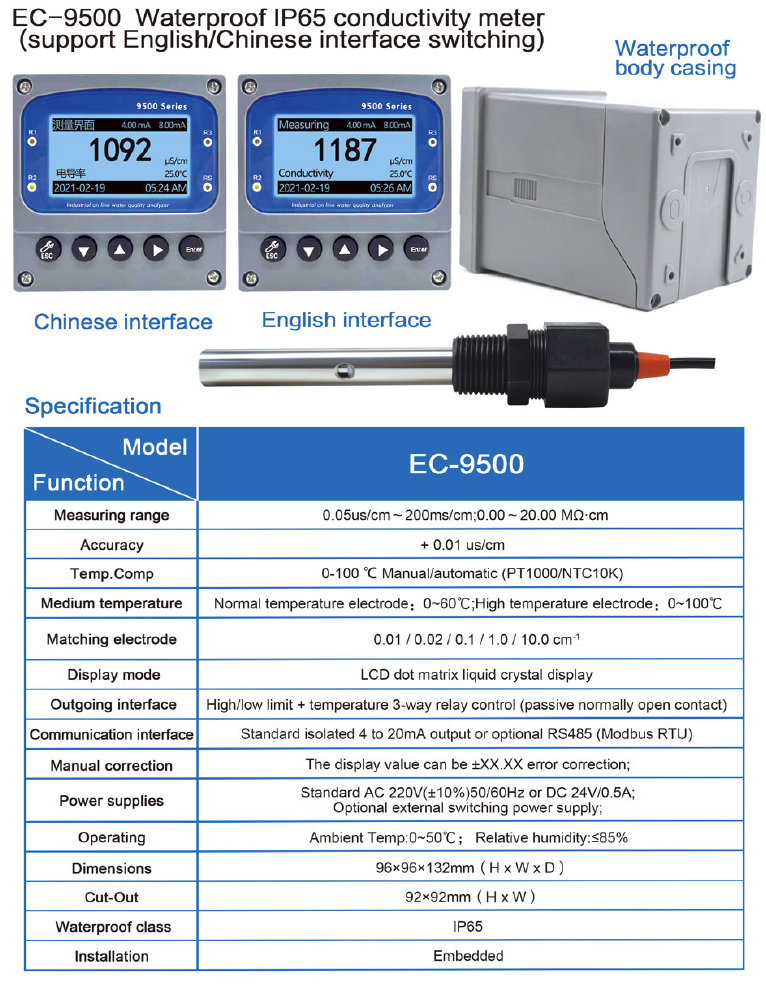
- Shanghai ChiMay’s 2-in-1 mini transmitters, multi-parameter sensors, in-line conductivity meters, and residual chlorine transmitters share a common wiring convention that lets a container skid be commissioned in half a shift instead of two days.
Why wiring is the hidden schedule risk
A membrane skid is often quoted with “72 hours from arrival to commissioning.” In practice, plants regularly slip to five or seven days. When project managers look for the root cause, mechanical issues account for a small share; the majority is wiring, terminations, and analyzer configuration.
The problem isn’t that field technicians lack skill. It’s that every project treats wiring as bespoke — different cable specifications, different pin assignments, different terminal blocks in every panel. Multiply that by twelve analyzers on a skid and the commissioning day becomes a puzzle rather than a checklist.
What “plug-and-play” actually means
Plug-and-play wiring is not a single feature. It’s a stack of specifications that collectively remove ambiguity from the wiring workflow:
- Standardized connector: M12 A-coded or M12 D-coded, chosen consistently across all analyzers on the skid.
- Standardized pin assignment: power on the same pins on every analyzer of the same class, digital signal on the same pins, drain wire on the same pin.
- Pre-terminated cordsets: cables cut and terminated in the factory, tested against a wiring drawing, shipped with the skid.
- Common cable specification: twisted-pair shielded, drain wire terminated at one end only, jacket rated for the ambient temperature of the container.
- Uniform color coding: brown for +24 VDC, blue for 0 V, black for signal A, white for signal B; applied everywhere.
Any deviation in any of these five items forces the field technician to open the drawing package and cross-check.
Product range and fit for a standardized skid
Shanghai ChiMay’s analyzer portfolio is designed around this standardization principle:
- 2-in-1 mini transmitter: M12 A-coded connector on the transmitter head, 4-pin power and communications; identical on every panel.
- Multi-parameter sensor and 4-in-1 sensor: single M12 connector at the probe head, digital Modbus output, single cordset per probe.
- In-line conductivity meter and residual chlorine transmitter: same wiring convention, same terminal color coding.
- Paddle wheel flow meter and turbine flow meter: pulse output plus Modbus, wired through the same M12 pattern.
- Softener valve and softening and filtering valve: valve controllers wired on the same convention, ready to daisy-chain onto the same RS-485 backbone.
The result is a skid where the field electrician sees the same cordset, the same connector, and the same pin assignment on every analyzer, regardless of parameter.
Comparing three wiring conventions in practice
Field data from 2026 modular skid commissioning shows a clear pattern:
- Custom terminal blocks per analyzer: 6-12 hours per sensor to commission; 40-55% of first-day issues traced to wiring.
- Mixed connectors, per-brand: 3-6 hours per sensor; 20-30% of first-day issues.
- Fully standardized M12 with pre-terminated cordsets: 1-2 hours per sensor; under 10% of first-day issues.
A twelve-analyzer skid can therefore save between 40 and 100 site-hours by adopting a plug-and-play standard, which typically translates to 1-2 days off the critical path.
Cable and shielding rules that matter
The connector alone doesn’t deliver low-noise sensor readings. Cable practice matters:
- Use twisted-pair shielded cable for Modbus RS-485, with a nominal impedance of 120 ohms.
- Terminate the shield at one end only, at the container panel side, not at the probe.
- Fit a 120 ohm termination resistor at each end of the RS-485 bus, not everywhere.
- Route analyzer cables away from motor and blower cables by at least 30 cm; where they must cross, cross at 90 degrees.
- Keep cordset runs under 30 m per Modbus segment, or use repeaters for longer runs.
Skids that ignore these rules will still work at commissioning and drift into intermittent errors after a few weeks of operation.
Field playbook: the wiring sequence
Field electricians commissioning a plug-and-play skid should follow the same sequence every time:
- Verify container earthing and bond continuity before energizing any panel.
- Confirm 24 VDC bus voltage under load on the panel.
- Plug the pre-terminated cordset into the analyzer, then into the panel; never leave the panel end open under power.
- Verify Modbus continuity end-to-end using a handheld tester before energizing the SCADA polling.
- Log the analyzer serial number, the port it’s plugged into, and the initial calibration reading in a single sheet.
The whole sequence is designed to be repeatable across brands, sites, and technician skill levels.
Design notes for the skid OEM
Skid OEMs adopting a plug-and-play convention should:
- Publish a wiring drawing package that shows the connector, pin assignment, and cordset specification for every analyzer.
- Insist that analyzer suppliers ship pre-terminated cordsets from the factory, not bulk cable.
- Adopt a single connector standard fleet-wide, not per project; the savings compound with the number of skids built.
- Include the wiring standard in the operations and maintenance manual, not only in the design drawings.
- Train the field electrician team on the standard once, not per project.
Commissioning checklist before handover
Before the modular skid leaves the container fabricator’s yard:
- Confirm every analyzer is fitted with the standard connector, not a project-specific variant.
- Test every pre-terminated cordset against the wiring drawing, using a continuity and insulation tester.
- Verify Modbus continuity end-to-end with the panel powered and the SCADA gateway connected.
- Record baseline sensor readings under running-water conditions, not only under dry-panel test.
- Provide the operator with a laminated wiring quick reference for future maintenance visits.
Applied consistently, plug-and-play wiring turns modular plant commissioning from a project-specific puzzle into a standardized workflow — the only way schedule promises are actually kept.