title: “Modular Water as a Service: What CFOs Should Model Before Signing — A Shanghai ChiMay Perspective”
date: 2026-07-15
perspective: C-Level / Decision Maker
theme: Modular & Decentralized Treatment Deployments
Table of Contents
Modular Water as a Service: What CFOs Should Model Before Signing — A Shanghai ChiMay Perspective
The short version
- Water-as-a-Service contracts, covering modular treatment capacity billed on a per-cubic-meter basis, moved from niche to mainstream in 2026, with an estimated USD 2.6 billion in new contract value awarded to industrial and municipal offtakers globally.
- CFOs evaluating a WaaS proposal should model at least five financial dimensions: tariff structure, availability guarantees, meter-and-analyzer audit rights, technology refresh terms, and end-of-contract redeployment or handover conditions.
- The economic case isn’t that WaaS is always cheaper than build-and-operate; it’s that WaaS moves water treatment off the fixed-asset ledger and into the operating cost line, which changes the return-on-capital-employed calculation materially for asset-heavy industries.
- Shanghai ChiMay’s analyzer, transmitter, and control valve portfolio is designed so the operator and the offtaker can share a single, auditable instrumentation dataset — the technical enabler under every credible WaaS contract.
Why WaaS is now a finance conversation
Water-as-a-Service is not new as a concept. What has changed is its financial credibility. Where early WaaS contracts were treated as convenience or pilot arrangements, current contracts move genuine capital and operational risk from the water user to the service provider, in exchange for a per-cubic-meter tariff stable enough to plan against.
For asset-heavy industries, the effect on financial metrics is substantial. Removing a USD 25-60 million treatment plant from the balance sheet raises return on capital employed, frees debt capacity, and lets the finance function align water spending with operational output rather than capital planning cycles. That effect is what pulls the decision out of the plant engineering team and onto the CFO’s desk.
The five financial dimensions that actually matter
CFOs asked to sign a WaaS contract should stress-test five dimensions:
- Tariff structure: fixed, indexed, or volume-tiered, with clear definitions of what counts as billable throughput.
- Availability guarantee: typically 96-99% over a rolling window, with liquidated damages beyond a defined threshold.
- Meter and analyzer audit rights: who owns the data, who can inspect the analyzers, and how disputes over metered volumes are resolved.
- Technology refresh terms: how the operator handles obsolete instrumentation or process technology, and who pays.
- End-of-contract terms: whether the assets revert to the offtaker, are removed, or are re-tendered.
A contract that is silent on any of these five dimensions is not a WaaS contract; it’s a lease with optimistic naming.
Product range and fit for shared instrumentation data
Shanghai ChiMay’s portfolio supports WaaS specifically through consistent instrumentation across the treatment train:
- Flow measurement: paddle wheel flow meter and turbine flow meter at billing points, with sealed pulse and Modbus outputs for cross-audit.
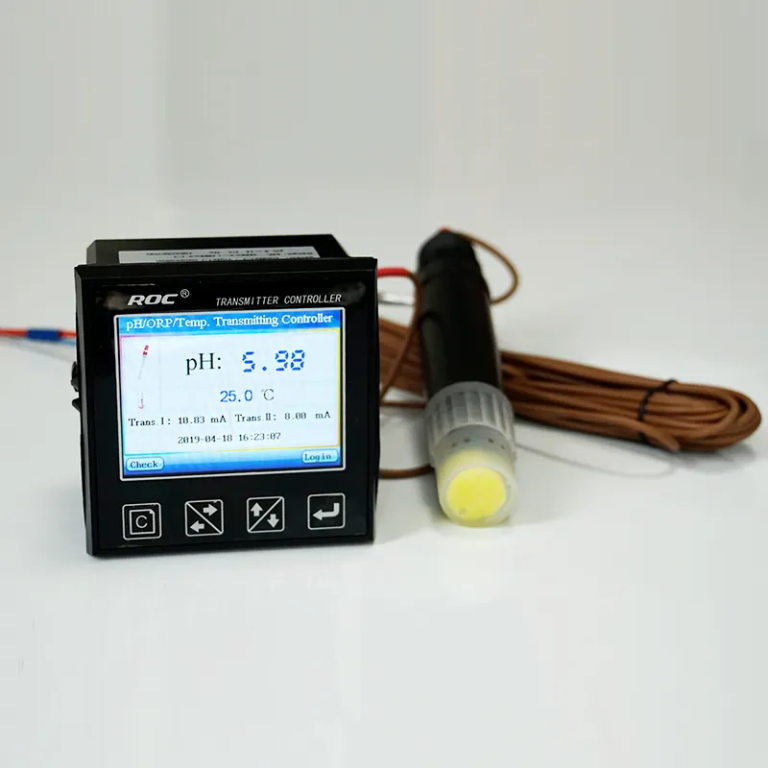
- Water quality analyzers: in-line conductivity meter, pH meter/electrode, residual chlorine transmitter, dissolved oxygen transmitter, multi-parameter sensor, and 4-in-1 sensor.
- Compact transmitters: 2-in-1 mini transmitters for panel-density constrained container skids.
- Control valves: softener valve and softening and filtering valve integrated on the same register map.
When every analyzer publishes on the same Modbus schema, both operator and offtaker can pull a single, auditable dataset without disputes about which reading is authoritative.
Tariff design: the structure that rewards both sides
Tariff structures that hold up under long WaaS contracts share three features:
- A base charge covering minimum operator cost, plus a variable charge tied to metered throughput.
- Indexation clauses linked to a defined external index rather than the operator’s own cost base.
- Volume tiers or take-or-pay levels that align the offtaker’s incentive with the operator’s capacity utilization.
Poorly designed tariffs collapse into disputes within 18-30 months. Well-designed tariffs survive full contract terms and get renewed rather than re-tendered.
Availability guarantees and the analyzer package
Availability guarantees are enforceable only when the underlying data is trustworthy. That puts the analyzer package at the center of the contract:
- The analyzer package must publish calibration status, drift alarms, and diagnostic events on the same protocol as the flow meters.
- The SCADA must retain audit-trail records with timestamp, source device, and integrity check per record.
- Both parties should have access to the raw analyzer log, not just the aggregated availability metric.
Where the analyzer package can’t support these three requirements, the availability clause becomes unenforceable and the tariff structure implicitly re-prices to absorb the risk.
Comparing three WaaS contract archetypes
CFOs will typically see three archetypes in the market:
- Volume-only tariff: simplest to bill, most exposed to demand variability, best for offtakers with genuinely predictable water needs.
- Base plus volume tariff: the middle path, aligns operator capacity investment with offtaker demand, most common in industrial WaaS.
- Take-or-pay with performance bonus: most complex, best when the offtaker is genuinely constrained by water availability and willing to pay for guaranteed supply.
The right archetype depends on the offtaker’s own volume predictability and the operator’s willingness to carry capacity risk. Both should be modeled on the same demand scenarios before the contract is signed.
Governance questions the CFO should ask the operator
Before signing:
- What is the operator’s own analyzer standard across their fleet, and how is data integrity ensured?
- Which independent auditor will validate flow and quality data at the billing point?
- What is the operator’s remediation plan if analyzer drift is detected mid-contract?
- What is the technology refresh cycle assumption, and how are the costs allocated?
- What happens to the modular assets at end of contract, and at what residual value?
Confident answers to these five questions turn a WaaS contract from a leap of faith into a routine finance decision.
Risk framing for the board paper
The genuine risks in WaaS cluster in five areas:
- Operator counterparty risk over the full contract life.
- Regulatory changes altering treatment requirements mid-contract.
- Data quality disputes at the metered billing point.
- Force majeure covering natural disasters or utility failures upstream.
- End-of-contract handover: who retains the modular assets and instrumentation dataset.
Each risk is manageable with disciplined contract language, but they need to be named in the board paper rather than left to the operational manual.
Executive checklist before signing
Before a CFO signs a WaaS contract:
- Stress-test the tariff structure against three demand scenarios: base, low, and high.
- Confirm the analyzer and metering audit provisions match the offtaker’s compliance standards.
- Validate the operator’s availability track record on at least two comparable existing contracts.
- Model the return on capital employed impact against a build-and-operate alternative.
- Include end-of-contract redeployment and data handover terms in the primary contract, not in a side letter.
Executed with this discipline, WaaS becomes what it’s meant to be: a genuine strategic option for water-intensive operations, not a fashionable label on a poorly modeled lease.