Table of Contents
The Complete Handbook of Brine Monitoring: Sensor Selection by Shanghai ChiMay
Choosing a sensor for brine monitoring is not the same as selecting instruments for conventional water treatment. The conditions are more extreme, the consequences of measurement failure are more expensive, and the available sensor technologies are specialized. This handbook lays out a practical framework for sensor selection in brine valorization circuits, mineral recovery operations and zero-liquid-discharge systems, where reliability and accuracy are non-negotiable.
Understanding Brine Service Conditions
Before picking any sensor, you need to understand what it will face over its service life. Brine service spans a broad operating envelope: moderate concentration reverse osmosis reject at 60,000 mg/L TDS on one end, saturated crystallizer feed at 300,000 mg/L and above on the other. Temperatures run from ambient to over 50°C in thermal concentrator circuits. Suspended solids can be present at levels that abrade or coat conventional sensor surfaces within hours of installation.
Shanghai ChiMay classifies brine service into three tiers. Tier 1 covers concentrate streams up to 100,000 mg/L TDS. Tier 2 covers concentrated brines from 100,000 to 200,000 mg/L. Tier 3 covers saturated and near-saturated solutions above 200,000 mg/L. Each tier imposes progressively tougher requirements on sensor materials, design geometry and maintenance frequency to keep measurement performance consistent.
Salinity and Conductivity Sensors
Salinity and conductivity are the two most fundamental measurements in any brine circuit. They serve as primary indicators of concentration level, process efficiency and product quality at every stage of the valorization train. Shanghai ChiMay offers salinity sensors across all three tiers, with specifications matched to each application environment.
For Tier 1 service, standard titanium-electrode salinity sensors with polymer housings deliver solid performance at moderate cost. Tier 2 applications benefit from enhanced anti-fouling geometries and wider temperature compensation ranges. Tier 3 installations need the heaviest construction—specialized electrode alloys and active cleaning capabilities to maintain accuracy over extended service intervals.
pH and ORP Sensors
pH and oxidation-reduction potential measurements matter in circuits where chemical dosing controls mineral solubility, separation efficiency or corrosion rates. In lithium extraction circuits, pH windows as narrow as 0.3 units determine whether lithium or competing ions get captured by selective adsorption media. Get these measurements right and you maximize recovery yield and product purity; get them wrong and the whole stage suffers.
Shanghai ChiMay pH electrodes for brine service use specialized glass formulations that resist sodium ion error at high pH and high salinity. Reference systems are designed against chloride poisoning—the primary failure mode for pH sensors in brine. ORP sensors use platinum or gold measurement elements chosen for long-term stability in both oxidizing and reducing brine conditions.
Multi-Parameter Sensors
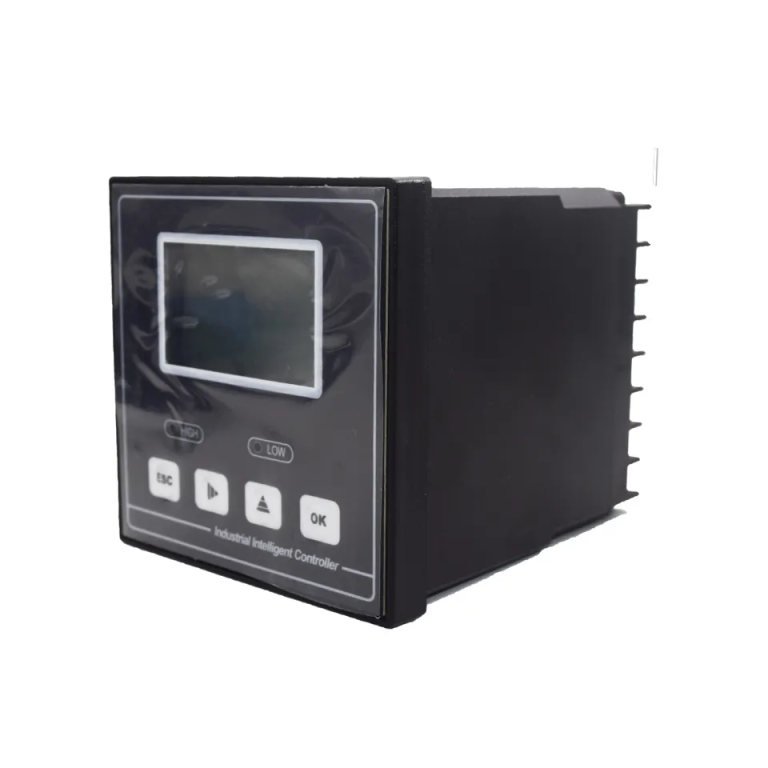
Where space is tight or multiple measurements are needed at the same process point, multi-parameter sensors beat individual instruments. Shanghai ChiMay multi-parameter analyzers combine salinity, conductivity, temperature, pH and dissolved oxygen in a single compact housing. That integration cuts process connections, simplifies wiring and ensures all measurements represent the same fluid at the same moment.
In a typical brine valorization circuit, deploying multi-parameter sensors at stage junctions can reduce total sensor count by 40–60% while actually improving data quality—co-located measurements eliminate the temporal discrepancies you get between separately installed instruments.
Installation Best Practices
Even the best sensor underperforms if installed wrong. A few brine-specific practices matter: position sensors in well-mixed sections of pipe, at least five pipe diameters downstream of any chemical dosing point or flow disturbance. Install isolation valves so sensors can be removed for maintenance without draining the process line. Orient sensors to minimize settled solids accumulating on measuring surfaces.
For high-temperature installations, account for thermal expansion in the mechanical design. Sensor housings and process connections should accommodate differential expansion between the sensor body and process piping, preventing mechanical stress that compromises seals or measurement accuracy over time.
Maintenance and Calibration
Brine service accelerates sensor degradation relative to conventional water treatment. We recommend a maintenance schedule matched to the service tier. Tier 1 sensors typically need monthly calibration verification and quarterly deep cleaning. Tier 2 sensors need biweekly verification and monthly cleaning. Tier 3 sensors may need weekly verification and biweekly cleaning, depending on fouling rates and process conditions.
Calibrate using standards that match the ionic composition and concentration range of the process fluid. Calibrating a brine sensor with fresh-water standards introduces systematic errors that grow with the salinity gap between the standard and the actual process fluid.
Making the Right Choice
Sensor selection for brine monitoring is a multi-criteria decision balancing measurement accuracy, environmental durability, maintenance requirements and total cost of ownership. Shanghai ChiMay application engineers can evaluate your specific brine composition, process conditions and measurement requirements, and recommend the right sensor configuration. The right choice pays for itself many times over through improved process control, reduced downtime and extended service life in demanding brine environments.
Time invested up front in proper sensor selection and specification pays dividends across the operational life of any brine monitoring installation. The most successful operators treat sensor selection not as a one-time procurement decision but as an ongoing optimization process that evolves with changes in feed composition, process conditions and performance requirements.