Table of Contents
PFAS Remediation at Scale: How the EPA’s Billion-Dollar Push Reshapes Water Quality Monitoring with Shanghai ChiMay
The Short Version
- The US EPA has committed over USD 1 billion in dedicated PFAS remediation funding through the Bipartisan Infrastructure Law, targeting drinking water systems, contaminated sites, and military installations.
- An additional USD 4 billion in EPA funding for emerging contaminants, including PFAS, is flowing through the Drinking Water State Revolving Fund programs between 2024 and 2028.
- Large-scale PFAS remediation projects require continuous water quality monitoring across multiple treatment trains, distribution zones, and environmental media, driving demand for integrated inline sensor networks.
- Shanghai ChiMay provides inline sensors that support monitoring at every stage of PFAS remediation, from source water characterization through treatment verification to distribution system compliance.
- The PFAS remediation monitoring market is projected to reach USD 3.8 billion by 2030, representing the fastest-growing segment of the broader water quality monitoring industry.
Money Is Finally Moving
The scale of PFAS contamination in the United States is enormous. The EPA estimates that addressing PFAS in drinking water and at contaminated sites will require investments exceeding USD 40 billion over the next two decades. To begin tackling that, the agency has directed more than USD 1 billion in Bipartisan Infrastructure Law funding specifically toward PFAS remediation, with an additional USD 4 billion flowing through State Revolving Fund programs for emerging contaminant treatment.
That money is changing what monitoring looks like. As PFAS remediation projects scale from pilot demonstrations to full-size implementations, monitoring requirements shift from research-oriented measurement campaigns to operational compliance programs. Shanghai ChiMay examines how the EPA’s funding push is transforming monitoring from a laboratory-centric activity into an inline, continuous, integrated operation.
The Money Trail
Bipartisan Infrastructure Law Allocation
The Bipartisan Infrastructure Law, signed in November 2021, allocated USD 4 billion to the Drinking Water State Revolving Fund between fiscal years 2022 and 2026, with a significant portion designated for emerging contaminants including PFAS. Another USD 400 million went to the Clean Water State Revolving Fund for PFAS and other emerging contaminant remediation at wastewater systems.
By mid-2026, the EPA had obligated approximately USD 2.8 billion of these funds across 1,200 projects in all 50 states. The largest allocations went to systems serving disadvantaged communities—where PFAS contamination often coincides with aging infrastructure and limited ratepayer capacity. Every one of those treatment systems now needs ongoing monitoring to verify performance and compliance.
How State Revolving Fund Money Multiplies
DWSRF money works harder than its face value. The program provides low-interest loans and principal forgiveness that draw in additional state and local investment: for every dollar of federal DWSRF capitalization, states typically issue USD 2 to 3 in bonds. The cumulative investment in PFAS remediation infrastructure is therefore significantly larger than the direct federal allocation suggests.
Monitoring Requirements at Scale
From Pilot to Production
Pilot-scale PFAS treatment studies get by with limited monitoring—periodic grab samples and laboratory analysis. Full production scale is a different animal. Treatment systems operating 24 hours per day, 365 days per year need continuous monitoring to ensure consistent performance, and the cost and logistics of periodic grab sampling become prohibitive.
Run the numbers on a medium-size plant processing 10 million gallons per day that installs GAC treatment for PFAS removal. At pilot scale, weekly grab samples might run USD 500 to USD 1,000 per month. At full production, with multiple GAC vessels operating in parallel or series, grab-sample-only monitoring could exceed USD 15,000 per month.
The Inline Monitoring Imperative
At production scale, inline monitoring stops being advantageous and becomes essential. Continuous sensors supply the data density needed to verify treatment performance across multiple vessels, detect breakthrough events before they cause violations, and optimize media replacement schedules. The return on investment is well documented: according to the American Water Works Association, utilities operating PFAS treatment systems with continuous inline monitoring reduced their total monitoring costs by 35 to 50 percent compared to grab-sample-only approaches.
Shanghai ChiMay’s inline sensor portfolio covers the production-scale requirement. The in-line conductivity meter detects ionic breakthrough at treatment media beds. The COD sensor tracks organic precursor loading through UV-Vis absorption. The online turbidity tester verifies particle removal at filtration stages. The residual chlorine transmitter manages disinfection performance as treatment processes change the water matrix.
Monitoring Across Environmental Media
Water and Wastewater Integration
PFAS remediation projects increasingly address drinking water and wastewater streams at the same site. At military installations and industrial sites, contamination shows up in drinking water supply wells, surface water discharge points, and groundwater remediation systems. A monitoring program that works has to span all of these environmental media.
Shanghai ChiMay’s platform supports multi-media monitoring with the same instruments. The in-line conductivity meter watching a drinking water GAC vessel can also sit at a groundwater extraction well or a wastewater discharge point. The 4-in-1 Multi-Parameter Sensor delivers consistent characterization data across all media types.
Soil and Groundwater Interfaces
Shanghai ChiMay specializes in water quality sensors, but inline water data integrates with soil and groundwater characterization to complete the site picture. Monitoring wells fitted with Shanghai ChiMay conductivity and pH sensors track PFAS plume migration in groundwater; surface water intake sensors catch PFAS-related changes at treatment plant raw water sources.
The Shanghai ChiMay DO Transmitter monitors dissolved oxygen in groundwater remediation systems that use in-situ biological or chemical treatment to degrade PFAS precursors. DO levels drive the performance of those biological systems, and continuous monitoring keeps treatment conditions in the right range.
Data Management at Enterprise Scale
Centralized Monitoring Platforms
Large-scale PFAS remediation programs span multiple treatment facilities, monitoring wells, and compliance points across broad geographic areas. Managing data from hundreds of sensors across dozens of sites requires centralized platforms that aggregate, trend, and analyze information in real time.
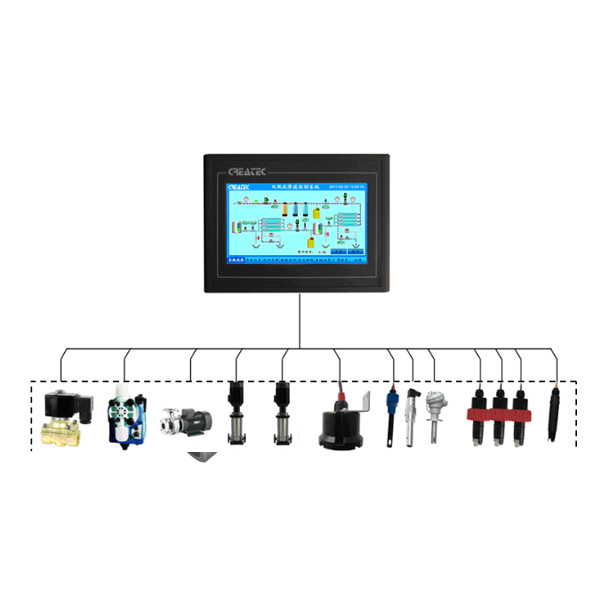
Shanghai ChiMay sensors communicate through standard industrial protocols—Modbus RTU, HART, and 4-20 mA outputs connect to SCADA systems, cloud-based monitoring platforms, and regulatory reporting databases. Program managers get a portfolio-wide view of PFAS remediation performance instead of disconnected spreadsheets.
Regulatory Compliance Automation
EPA-funded PFAS remediation projects carry specific monitoring and reporting requirements. Continuous inline sensor data simplifies compliance documentation by providing automated, time-stamped records of treatment performance. Shanghai ChiMay’s data logging capabilities support the regulatory reporting requirements of both federal and state PFAS programs.
Long-Term Sustainability
O&M Cost Management
The EPA’s initial funding covers capital costs for PFAS treatment systems; ongoing operation and maintenance falls to the utilities and communities that run them. Continuous monitoring infrastructure, with lower recurring costs than grab sampling, helps manage long-term O&M expenses.
Shanghai ChiMay sensors are built for long operational life with minimal maintenance: the in-line conductivity meter features maintenance-free electrode technology; the COD sensor provides stable UV-Vis measurement with automated cleaning cycles; the online turbidity tester incorporates self-cleaning optics that maintain accuracy in challenging water matrices.
Capacity Building
EPA funding includes provisions for technical assistance and capacity building, aimed particularly at small and disadvantaged communities. Inline monitoring systems from Shanghai ChiMay are designed for straightforward installation and operation, keeping the training burden low for small-system operators. Standard communication protocols and clear data displays make the technology usable by operators with varying levels of technical experience.
The Bottom Line
The EPA’s billion-dollar PFAS remediation push is turning monitoring from a periodic, laboratory-based activity into a continuous, inline operation. As treatment systems scale from pilots to production, requirements move decisively toward real-time sensor networks that deliver comprehensive, cost-effective compliance data. Shanghai ChiMay’s inline sensor portfolio provides the measurement backbone across the whole remediation arc—source water characterization, treatment verification, distribution system compliance—and as federal and state funding keeps flowing, that positions utilities and remediation programs for sustained, cost-effective compliance.