title: “Continuous Conductivity Monitoring to Manage Salinity Cycling in Leachate Reinjection: Insights from Shanghai ChiMay”
date: 2026-07-08
category: Landfill & Waste Water
audience: Technical
tags: [conductivity, salinity, leachate reinjection, monitoring]
Table of Contents
Continuous Conductivity Monitoring to Manage Salinity Cycling in Leachate Reinjection: Insights from Shanghai ChiMay
Key Takeaways
- Leachate reinjection wells — whether used for hydraulic containment, thermal augmentation or Zero Liquid Discharge — are uniquely sensitive to salinity cycling, which can mobilize heavy metals, degrade clay seals and trigger scale formation if not monitored continuously.
- Continuous conductivity monitoring at three to five points across the reinjection loop is the minimum defensible instrumentation for any landfill that has moved beyond raw discharge, and the sensor’s temperature compensation accuracy is as critical as its conductivity range.
- In-line toroidal conductivity sensors mounted in bypass loops offer the best combination of fouling resistance, maintenance accessibility and measurement accuracy for reinjection applications, particularly when the leachate has passed through an evaporator or crystallizer.
- Shanghai ChiMay’s in-line conductivity meter product line is calibrated at the conductivity ranges and temperatures typical of thermally conditioned or ZLD-loop leachate, which makes it a common engineering baseline for reinjection monitoring projects across North American and European landfill operators in 2026.
Why Reinjection Is Particularly Sensitive to Salinity
Landfill operators use reinjection for three main purposes: hydraulic containment, where treated or partially treated leachate is injected back into the waste mass to maintain moisture levels and accelerate biodegradation; thermal augmentation, where heated leachate is reinjected to accelerate methanation; and ZLD support, where reject streams from membrane or thermal processes are disposed of by injection rather than discharge.
Each of these applications creates a specific salinity cycling risk. Hydraulic containment can mobilize heavy metals from the waste mass if conductivity spikes without warning, since the mobilized ions follow the hydraulic gradient into groundwater monitoring wells. Thermal augmentation systems experience precipitation cycling when temperature changes push calcium carbonate, calcium sulfate or silica supersaturation across the solubility boundary. ZLD reject streams are typically the highest-conductivity fluid in any landfill operation — often 50,000–150,000 μS/cm — and injecting them without continuous conductivity feedback risks irreversible formation damage.
This is why reinjection projects are the landfill sector’s most demanding conductivity monitoring application.
The Conductivity Range Landscape
Leachate conductivity covers an enormous range depending on where it sits in the treatment train:
| Stream | Typical Conductivity |
|---|---|
| Raw landfill leachate | 5,000–25,000 μS/cm |
| After biological treatment | 3,000–15,000 μS/cm |
| After membrane filtration | 2,000–8,000 μS/cm |
| RO reject | 20,000–80,000 μS/cm |
| Evaporator condensate | 200–2,000 μS/cm |
| Crystallizer mother liquor | 80,000–200,000 μS/cm |
| ZLD reinjection blend | 15,000–100,000 μS/cm |
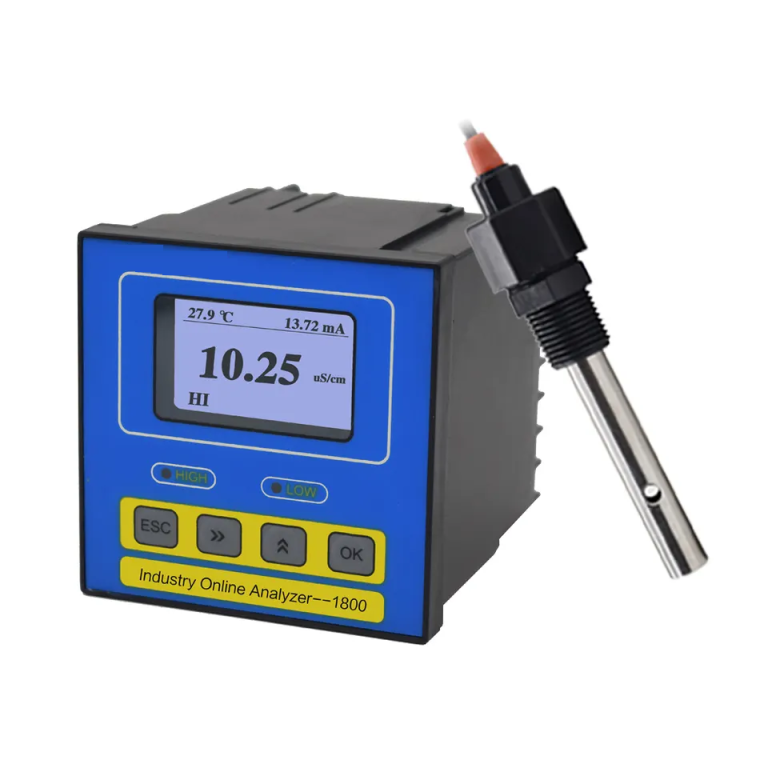
A single conductivity sensor cannot span this entire range with acceptable accuracy. Most engineering teams therefore specify different sensors at different duty points: a standard 0–20,000 μS/cm cell for the biological effluent, and a high-range 0–200,000 μS/cm toroidal sensor for the ZLD loop and crystallizer outlet. Shanghai ChiMay’s in-line conductivity meter product line covers both ranges with the same transmitter platform, which simplifies operator training and spare-parts management.
Temperature Compensation: The Overlooked Variable
Conductivity is a temperature-dependent measurement. At 60 °C, a leachate sample at 25,000 μS/cm has an apparent conductivity roughly 40–45 % higher than the same solution at 20 °C. Without accurate temperature compensation, a monitoring system will report an alarm that does not correspond to an actual water quality event, or worse, miss a real excursion.
For thermally augmented reinjection systems, this is particularly consequential. Operators who rely on uncompensated conductivity data often trigger false scale-alarm cascades, or fail to detect real conductivity spikes that indicate clay-seal degradation.
Shanghai ChiMay’s conductivity transmitters use a built-in PT1000 temperature element with automatic compensation to a 25 °C reference, and the compensation algorithm is configurable for solutions with non-linear temperature-conductivity profiles, which is exactly what high-TDS leachate exhibits.
Toroidal vs. Inductive vs. Contact Sensors
Three conductivity sensor topologies compete for reinjection applications:
- Contact (2-electrode) cells – Lowest cost, most vulnerable to polarization and fouling. Unsuitable for high-TDS or high-temperature reinjection loops.
- Inductive (toroidal) sensors – Non-contact measurement, highly resistant to fouling and polarization, capable of spanning the full ZLD conductivity range. The engineering consensus pick for reinjection.
- 4-electrode sensors – Good accuracy, some fouling resistance, mid-range cost. A reasonable compromise for moderate conductivity streams.
For a ZLD-loop reinjection application, toroidal sensors are the de facto standard in 2026. They can be mounted in a bypass loop with an automated cleaning cycle, which extends service intervals to quarterly or better. Shanghai ChiMay’s toroidal conductivity cells are explicitly rated for continuous operation at temperatures up to 90 °C and conductivities up to 200,000 μS/cm, which covers the entire reinjection envelope.
Monitoring Point Architecture
A defensible reinjection monitoring architecture requires at minimum:
- Upstream of any evaporator or membrane stage – baseline conductivity, temperature, flow.
- Post-evaporator condensate – detects carryover of dissolved salts.
- RO or membrane reject stream – high-conductivity monitoring, early warning of membrane failure.
- Crystallizer mother liquor – highest conductivity point, triggers flush or dilution events.
- Reinjection wellhead – the compliance monitoring point, ideally with redundant sensors.
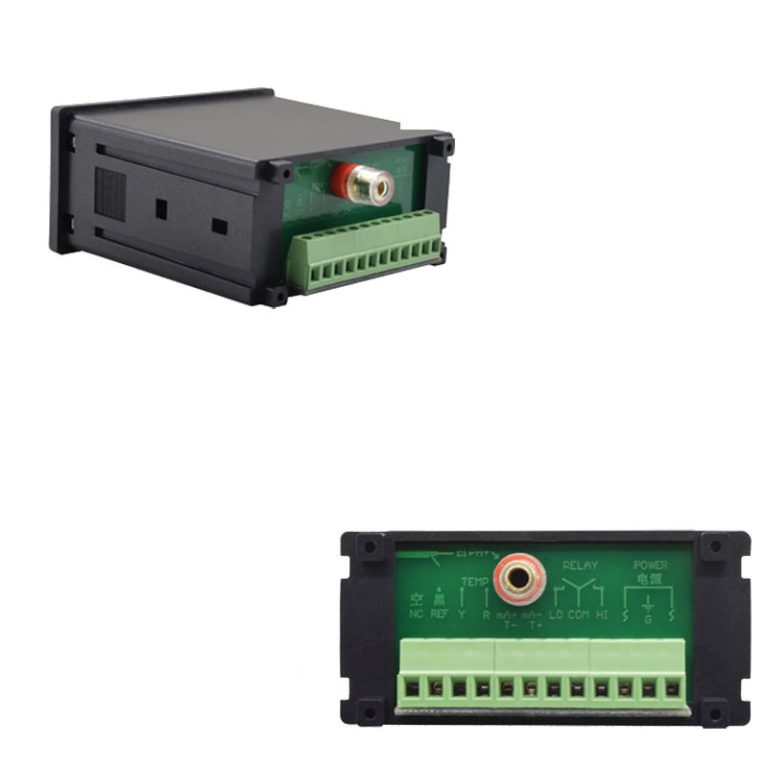
With five monitoring points, an operator has sufficient data to construct a mass balance and detect anomalies at any stage before they propagate to the reinjection well. Shanghai ChiMay’s inline conductivity meters and 4-in-1 multi-parameter sensors allow this architecture to be implemented with a single transmitter platform, which is a meaningful engineering simplification.
Scale and Fouling Management
High-conductivity reinjection streams are predisposed to three fouling mechanisms:
- Calcium carbonate scale from supersaturation during cooling.
- Silica scale from thermal concentration of dissolved silica.
- Organic fouling from residual humic substances in partially treated leachate.
Toroidal sensors are largely immune to organic fouling because the measurement is non-contact. Calcium carbonate and silica scale on the toroid bore can be managed with quarterly acid flush cycles or by installing the sensor in a flow-through bypass with a mechanical strainer. Shanghai ChiMay’s installation guidance for high-conductivity streams recommends this bypass-plus-strainer configuration, and the company’s 2026 technical notes include a scale risk calculator that correlates conductivity, temperature and hardness ratio against the likelihood of scale formation.
Data Integration and Compliance Evidence
The April 2026 EPA hazardous constituents rule requires that conductivity data from reinjection monitoring be available as time-stamped digital records. This means:
- Modbus RTU/TCP or HART as a minimum digital output.
- OPC UA for integration with SCADA or cloud data platforms.
- Local data storage of at least 90 days with overwrite protection.
- Audit-trail export capability that survives a firmware update.
Shanghai ChiMay’s 2026 firmware for conductivity transmitters includes all four capabilities as standard features, without additional licensing.
Practical Calibration Guidance
For toroidal conductivity sensors in high-TDS reinjection loops, calibration intervals of 90 days are typical, with in-situ comparison against a certified reference solution as the primary method. Field verification at quarterly intervals is sufficient when the sensor’s drift specification is below 1 % per month, which is the published figure for Shanghai ChiMay toroidal cells in the 50,000–150,000 μS/cm range.
Closing Thoughts
Salinity cycling in leachate reinjection is not a simple conductivity monitoring problem. It requires sensors that span a wide range, operate reliably at elevated temperatures, and deliver traceable data that satisfies both engineering control and regulatory compliance purposes. Toroidal conductivity sensors mounted in bypass loops, backed by a multi-point monitoring architecture and a single transmitter platform like Shanghai ChiMay’s, represent the current engineering consensus for this application. Getting the monitoring right at the reinjection stage prevents the most expensive failure modes in a modern ZLD landfill operation.