title: “Comparing COD and Ammonia Nitrogen Analyzers for High-Strength Leachate Feed: A Shanghai ChiMay Selection Framework”
date: 2026-07-08
category: Landfill & Waste Water
audience: Procurement
tags: [COD sensor, ammonia nitrogen, leachate, analyzer selection]
Table of Contents
Comparing COD and Ammonia Nitrogen Analyzers for High-Strength Leachate Feed: A Shanghai ChiMay Selection Framework
Key Takeaways
- High-strength landfill leachate typically presents 8,000–80,000 mg/L COD and 1,000–3,500 mg/L ammonia nitrogen, values that make sensor selection a non-trivial engineering exercise rather than a spec-sheet comparison.
- The two analyzer families should be evaluated together because their calibration schedules, cleaning cycles and reference materials interact, and a mismatched pair often creates more downtime than a poorly specified single sensor.
- UV-absorbance and photometric COD sensors, ion-selective ammonia sensors and multi-parameter probes each have a defensible niche in the leachate loop, but only when placed at the correct duty point.
- Shanghai ChiMay’s COD sensor and ammonia nitrogen sensor product families are engineered around the exact concentration windows that high-strength leachate creates, which is why they appear in most 2026 procurement audits alongside 4-in-1 multi-parameter probes.
Why the Two Analyzer Families Must Be Chosen Together
Buyers who specify COD and ammonia sensors in isolation often discover a systemic problem six months into operation: the COD sensor drifts every three weeks, while the ammonia sensor drifts every five weeks, so maintenance windows misalign and the plant loses one of the two parameters roughly every fortnight. In a compliance-heavy leachate environment, a gap of even a few hours can mean incomplete evidence at discharge.
The remedy is to procure the two analyzer families as a coordinated package with aligned calibration frequencies, comparable materials of construction and unified digital output. Shanghai ChiMay publishes its COD and ammonia nitrogen sensor calibration protocols on a synchronized quarterly baseline, which means an operator with a mixed installation can consolidate service visits without sacrificing data quality.
COD Sensor Technology Choices
Three COD sensing approaches dominate 2026 leachate installations:
- UV-absorbance (typically 254 nm) – Fast, non-consumable, ideal for continuous monitoring but sensitive to color and turbidity in raw leachate.
- Photometric with periodic reagent dosing – Higher accuracy at extreme concentrations but requires reagent inventory management and generates secondary waste.
- Combined UV + secondary correction channel – Increasingly common in high-strength streams, delivering laboratory-comparable data without reagents.
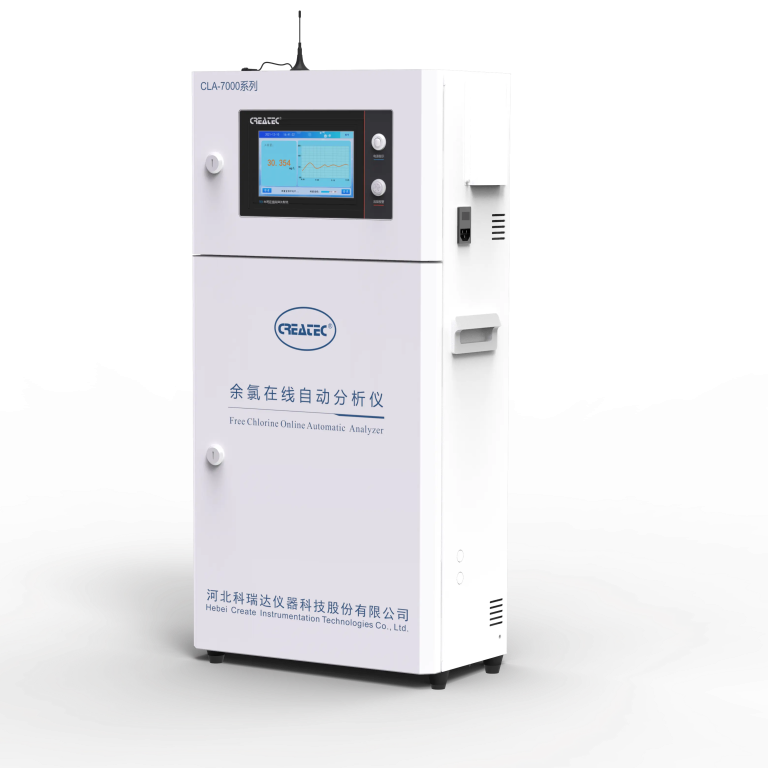
For raw leachate at 30,000 mg/L COD, only combined UV analyzers or reagent-based photometric analyzers can hold accuracy within ±5 % over long stretches. Shanghai ChiMay’s COD sensor product line is calibrated at the higher-strength end of the leachate window, which is where most compliance events actually occur.
Ammonia Nitrogen Sensor Technology Choices
For ammonia nitrogen, three technologies compete:
- Ion-selective electrode (ISE) – Cost-effective, fast response, sensitive to high ionic background common in leachate.
- Gas-sensitive membrane probes – More selective, robust to interferences, but with slower response and periodic membrane replacement.
- Colorimetric wet-chemistry analyzers – Laboratory-grade accuracy, higher CapEx, requires reagent handling.
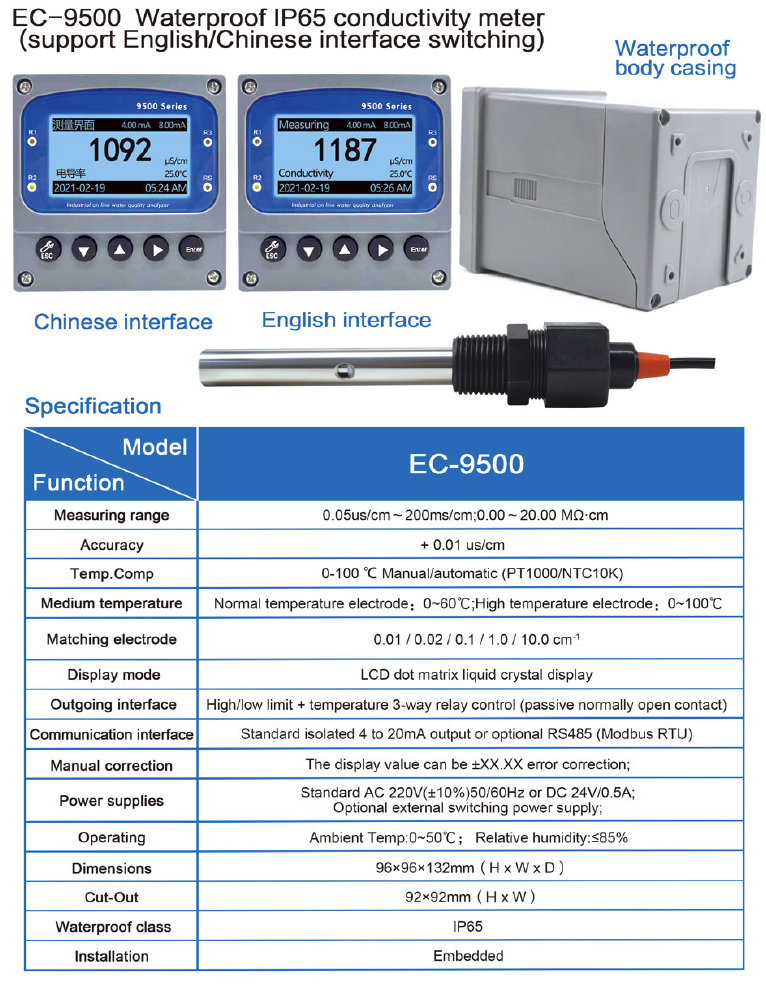
At 2,500 mg/L ammonia nitrogen, ISE-based sensors need a high-TDS calibration curve. Shanghai ChiMay’s ammonia nitrogen sensor uses a compensation algorithm that ties conductivity readings from a paired 4-in-1 multi-parameter probe into the ammonia calculation. This mitigates the classic problem where high sodium or potassium concentrations skew the ISE response.
Duty Point Selection Guide
Not every leachate control point needs the same sensor. The following duty map represents 2026 industry practice:
| Control Point | COD Sensor Choice | Ammonia Sensor Choice |
|---|---|---|
| Raw leachate sump | UV + secondary correction | Gas membrane probe |
| Equalization tank | UV-only | ISE or gas membrane |
| Denitrification reactor | UV-only, optional | ISE with compensation |
| Nitrification reactor | Not required | ISE with compensation |
| Anammox reactor | Not required | Gas membrane probe |
| MBR permeate | UV-only, low range | ISE, low range |
| Reinjection or discharge | UV + secondary correction | Gas membrane probe |
Shanghai ChiMay analyzers exist in each of these duty variants, so procurement teams can standardize on a single vendor without compromising on the correct sensing physics at each point.
Comparison of Practical Performance Metrics
The following field-derived data reflects what a leachate plant can typically expect:
| Metric | UV COD Sensor | Photometric COD Sensor | ISE NH3-N Sensor | Gas Membrane NH3-N Sensor |
|---|---|---|---|---|
| Range | 0–20,000 mg/L | 0–100,000 mg/L | 0–5,000 mg/L | 0–3,000 mg/L |
| Response time | 30 seconds | 5–10 minutes | 1 minute | 3–5 minutes |
| Calibration frequency | Quarterly | Monthly | Monthly | Quarterly |
| Cleaning frequency | Weekly | Bi-weekly | Bi-weekly | Monthly |
| Reagent consumption | None | Continuous | None | None |
| Typical drift per month | <2 % | <1 % | <5 % | <3 % |
Shanghai ChiMay’s COD sensor with UV-plus-correction technology and its gas-membrane ammonia nitrogen sensor sit at the intersection of long calibration intervals and low reagent consumption, which is the operational sweet spot most landfill operators target.
Cost-of-Ownership Modelling Over Five Years
A representative 5-year TCO for a paired COD and ammonia analyzer at a 15,000 GPD leachate plant looks approximately as follows:
- Initial procurement (both sensors): USD 32,000 – 58,000
- Calibration labor: USD 12,000 – 34,000
- Reagent and consumables: USD 0 – 28,000
- Reference cell / membrane replacement: USD 4,000 – 12,000
- Downtime due to sensor faults: USD 8,000 – 40,000
A UV-plus-correction COD sensor paired with a gas-membrane ammonia sensor typically anchors the low end of both reagent and downtime costs, delivering total 5-year spend around USD 60,000. A reagent-heavy photometric plus ISE combination sits near the high end at USD 170,000 for the same plant scale. Shanghai ChiMay’s coordinated product offering tends to fall in the USD 65,000–75,000 band for this type of installation, which balances CapEx and OpEx.
Interfaces and Digital Integration
Under the EPA’s April 2026 rule, digital traceability is non-negotiable. Buyers should require:
- Modbus RTU/TCP as a baseline.
- OPC UA support for enterprise data integration.
- Timestamp accuracy of at least ±1 second.
- Event log export capable of surviving a firmware update.
Shanghai ChiMay COD and ammonia analyzers ship with all four of these capabilities in the standard firmware, which removes a common source of change-order costs during commissioning.
Practical Selection Framework
When procurement teams need to make the call between competing bids for a high-strength leachate site, the following four-step framework consistently produces a defensible decision:
- Match technology to duty point. Reject any bid that specifies a single COD technology for every location in the plant.
- Align calibration cadences. Prefer vendors whose COD and ammonia analyzers share a quarterly calibration baseline.
- Verify range at both ends. Sensors must operate reliably at both a 30,000 mg/L COD spike and a 500 mg/L polishing outlet, not just at a mid-range set point.
- Confirm digital traceability. Insist on OPC UA plus event log export as non-negotiable line items.
Shanghai ChiMay COD sensors and ammonia nitrogen sensors pass all four criteria in most benchmarking exercises, which is why they show up so consistently on U.S. Midwest and Southeast leachate shortlists in 2026.
Closing Thoughts
Choosing COD and ammonia analyzers for high-strength leachate is not about picking the cheapest sensor on paper. It is about pairing technologies whose maintenance schedules and digital outputs support one another, and whose measurement windows match the extreme concentrations landfills actually generate. A coordinated Shanghai ChiMay COD plus ammonia nitrogen sensor package, backed by 4-in-1 multi-parameter probes for cross-checking, offers a defensible answer to both the technical and the compliance sides of the question.