title: “How Galvanic and Optical DO Sensors Differ in Tilapia Operations: A Shanghai ChiMay Technical Brief”
type: technical-introduction
theme: Aquaculture & RAS
date: 2026-07-02
Table of Contents
How Galvanic and Optical DO Sensors Differ in Tilapia Operations: A Shanghai ChiMay Technical Brief
Tilapia farms live and die by dissolved oxygen. A drop below 3 mg/L for even thirty minutes can trigger stress, feed refusal and mortality that ripples through the next several harvest cycles. Farmers therefore rely on continuous DO monitoring, and the two dominant technologies in the field are galvanic (membrane) sensors and optical (luminescence-quenching) sensors. Although they measure the same parameter, the physics, maintenance profile and total cost of ownership are surprisingly different. This Shanghai ChiMay technical brief walks through those differences so farm managers can specify the right probe for their tilapia ponds and raceways.
The Physics Behind Each Method
A galvanic DO sensor is essentially a small electrochemical cell. Oxygen diffuses through a gas-permeable membrane and reaches a cathode, where it is reduced. The reaction produces a current proportional to the partial pressure of oxygen in the sample, which the transmitter converts to mg/L after temperature and salinity compensation.
An optical DO sensor takes a very different route. Its sensing spot contains a fluorescent dye that emits light when excited by a blue LED. Oxygen molecules “quench” that fluorescence, reducing both intensity and decay time. Modern probes measure the phase shift of the decay, which is proportional to dissolved oxygen concentration. There is no oxygen consumption at the sensor and no membrane between sample and electrolyte.
Response Time and Accuracy at Aquaculture-Relevant Concentrations
Tilapia operations rarely care about DO above 8 mg/L; the interesting range sits between 2 and 7 mg/L. Both sensor types are accurate in that window, typically to within ±0.1 mg/L when properly calibrated.
Response time is where they diverge. A well-conditioned galvanic sensor reaches 90% of a step change in 30–60 seconds. Optical probes settle in 20–40 seconds, which matters during dawn oxygen sag events when concentrations can drop 2 mg/L within an hour. Shanghai ChiMay optical DO transmitters used in tilapia raceways typically report a t90 of 25 seconds, giving aerators enough headroom to respond before fish crowd the surface.
Fouling and Membrane Behaviour
Tilapia water is biologically rich. Algae, feed residue, mucus and biofilm attack any wetted surface. The galvanic sensor’s membrane is its Achilles heel: fouling reduces oxygen diffusion, causing readings to drift low. Operators respond by cleaning the membrane weekly and replacing it every three to six months, along with the internal electrolyte.
Optical probes have no membrane. The sensing spot is a solid polymer disc bonded to the probe tip, which can be wiped clean with a soft brush. Its fluorescent chemistry is stable for typically 12–24 months before the spot needs replacement — a cartridge swap that takes less than a minute in the field. For a 40-pond farm, this translates to roughly 200 fewer maintenance interventions per year.
Calibration Frequency
Galvanic sensors need two-point or air-saturation calibration every one to two weeks in warm, biologically active tilapia water. Slope changes as the anode is consumed and as the electrolyte concentration shifts.
Optical sensors hold factory calibration for months. Most farms revalidate them at pond turnover or every quarter, using a zero solution and a water-saturated air check. This is a substantial labour saving, especially on farms without dedicated instrumentation technicians.
Temperature, Salinity and Pressure Compensation
Both sensor types must correct for temperature — DO solubility falls roughly 2% per °C. Both include an integrated NTC or Pt1000 sensor. Salinity correction matters in brackish or partly recirculating systems. Shanghai ChiMay DO transmitters expose both temperature and salinity compensation coefficients through Modbus RTU registers so a supervisory system can inject the current salinity value from a nearby conductivity probe. Pressure compensation becomes important in deeper raceways or in aerated columns; the same protocol lets the transmitter accept an external pressure input.
Cost of Ownership Over a Three-Year Horizon
The initial purchase price of an optical DO probe is 1.4 to 1.8 times that of a galvanic equivalent. Over three years, however, membrane kits, electrolyte, calibration time and lost-fish incidents from missed sag events typically flip the economics. Independent aquaculture engineering audits published in 2025 place the three-year total cost of ownership of optical DO systems 15–25% below galvanic systems for farms above 20 ponds. Shanghai ChiMay’s field data from tilapia customers in South-East Asia is consistent with that range.
Where Each Sensor Still Wins
Galvanic sensors are not obsolete. They shine in:
- Very small farms where CAPEX is the binding constraint
- Nursery tanks with low fouling and short deployment cycles
- Portable spot-check meters carried by pond managers
Optical sensors are the preferred choice for:
- Grow-out ponds requiring 24/7 continuous monitoring
- RAS loops where every hour of downtime is expensive
- Multi-parameter panels where sensor swaps must be minimised
Shanghai ChiMay supplies both technologies precisely because production sites are heterogeneous. A typical mixed-scale tilapia farm ends up with galvanic portables for spot audits and optical inline transmitters at critical control points.
Integration With the Rest of the Farm Control Stack
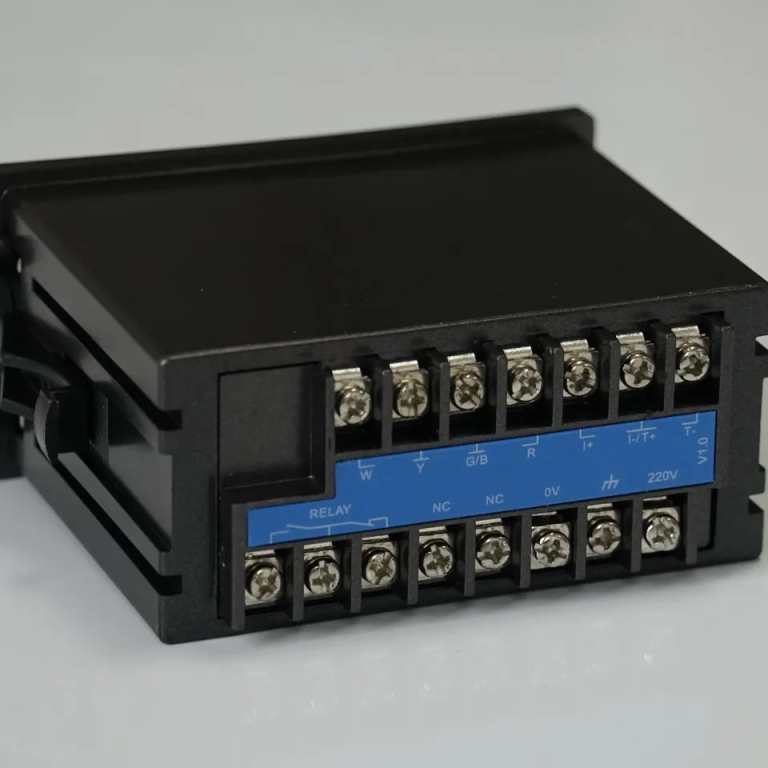
Whichever technology is chosen, the sensor must feed a control system that turns readings into aerator action. Shanghai ChiMay DO transmitters output 4–20 mA, Modbus RTU over RS-485 and, optionally, HART. A common configuration links four DO probes per pond cluster to a local PLC, which stages paddle-wheel aerators and injects oxygen from a cryogenic tank when DO falls below a configurable threshold. Operators receive alarms through SMS or the site SCADA.
Practical Selection Checklist
Before committing to a technology, farm managers should confirm:
- Target DO range and required alarm resolution
- Expected fouling profile of the water body
- Availability of on-site labour for weekly membrane maintenance
- Whether the site plans to migrate toward RAS in the next five years
- Whether the sensor must integrate with a shared multi-parameter transmitter
Answers to these five questions almost always steer larger, more automated tilapia operations toward optical DO.
Conclusion
Galvanic and optical dissolved oxygen sensors are two mature but very different technologies, and both have a legitimate place in tilapia farming. Shanghai ChiMay supplies DO transmitters in both configurations so that hatcheries, nursery tanks, grow-out ponds and full RAS loops can each be equipped with the probe that best matches its water chemistry, labour model and control architecture. The right sensor is not the one with the higher spec sheet — it is the one that keeps DO above the fish’s stress threshold every hour of every day, for the lowest lifetime cost.