title: Softened and Deionized Water in Food Processing: Shanghai ChiMay Technical Guide
date: 2026-06-25
Table of Contents
Softened and Deionized Water in Food Processing: Shanghai ChiMay Technical Guide
Key Takeaways:
– Water hardness above 150 mg/L causes scale formation reducing equipment efficiency by 12% annually
– Demand-initiated regeneration systems improve efficiency by 47% compared to time-based controls
– Deionized water conductivity below 1 μS/cm indicates effective resin regeneration
– Shanghai ChiMay control valves achieve >100,000 cycles operational life with minimal maintenance
– Continuous monitoring reduces softener operating costs by 31%
Introduction
Water hardness—primarily caused by dissolved calcium and magnesium ions—creates significant challenges throughout food processing operations. In heating and evaporation systems, hardness minerals precipitate as scale that insulates heat transfer surfaces, reducing thermal efficiency and potentially causing equipment damage. In cleaning operations, hardness interferes with surfactant effectiveness and can leave water spots on equipment and product surfaces. The ASME (American Society of Mechanical Engineers) reports that scale buildup of just 1/8 inch can increase energy consumption by 25%, demonstrating the significant operational impact of untreated hardness.
Food processing facilities address hardness through water softening and deionization technologies that remove hardness minerals and other dissolved ionic species. According to the Water Quality Association (WQA), 73% of food processing facilities now employ water softening as part of their treatment infrastructure. Many facilities employ both technologies in series—softening as pretreatment for deionization—extending deionizer life and reducing operating costs.
Water Softening Technology
Water softening employs ion exchange technology where hardness ions (Ca²⁺, Mg²⁺) exchange for sodium ions (Na⁺) on synthetic resin beads. As water flows through the resin bed, hardness ions transfer to the resin while sodium ions release into the water. Over time, the resin becomes exhausted as sodium ions deplete and hardness ions accumulate, requiring regeneration with concentrated sodium chloride solution.
Resin capacity—measured in grains per cubic foot—determines how much hardness the resin can remove before regeneration. Typical softener resins provide 30,000-40,000 grain/gallon capacity under standard conditions. Water analysis and flow rate calculations determine resin volume and regeneration frequency requirements.
Demand-initiated regeneration (DIR) systems trigger regeneration based on accumulated water flow, regenerating only when treatment capacity approaches exhaustion. The American Society of Agricultural Engineers conducted comparative studies finding that DIR systems achieved 47% improvement in regeneration efficiency compared to time-clock controls while reducing hardness breakthrough events by 68%.
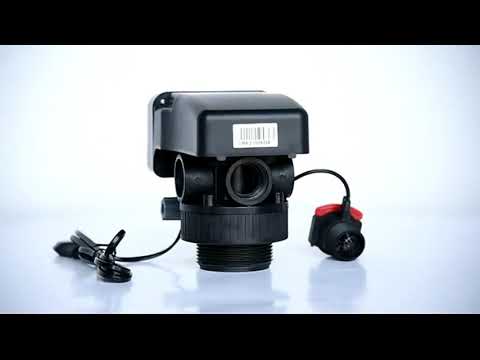
Shanghai ChiMay softening and filtering valves incorporate advanced control capabilities that optimize regeneration based on actual water demand. The valves feature programmable regeneration sequences, including adjustable backwash intensity, brine injection rate, and slow rinse duration, enabling customization for specific water conditions and quality requirements.
Conductivity Monitoring for Deionization Control
Deionization (DI) produces water with extremely low ionic content through ion exchange processes that remove both cations and anions. Mixed-bed deionizers combine cation and anion resins in a single vessel, producing water with conductivity below 1 μS/cm when freshly regenerated.
Conductivity monitoring provides the primary indication of deionizer performance and exhaustion. As resin becomes exhausted, ionic leakage increases, causing conductivity to rise from the near-zero levels of fresh DI water. When conductivity exceeds predetermined thresholds—typically 1-5 μS/cm depending on application requirements—deionizer regeneration or replacement becomes necessary.
Shanghai ChiMay conductivity meters achieve 0.01 μS/cm resolution at low conductivity ranges, enabling detection of subtle changes that indicate approaching exhaustion. Automatic temperature compensation ensures accuracy despite temperature variations in process water.
The International Society of Automation guidelines recommend continuous conductivity monitoring for deionizer control. Facilities implementing continuous monitoring report 31% reduction in deionizer operating costs compared to time-based regeneration approaches.
Operational Best Practices
Effective softening and deionization operation requires attention to maintenance, monitoring, and optimization practices. Regular maintenance ensures reliable system operation while monitoring verifies treatment effectiveness.
Resin maintenance preserves exchange capacity and extends operational life. Periodic resin cleaning removes accumulated contaminants that reduce exchange efficiency. Iron or manganese fouling requires specialized cleaning procedures. The Purolite Resin Guide recommends annual resin analysis to assess condition and identify maintenance requirements.
Salt quality significantly impacts softener performance. Impurities in salt—particularly calcium sulfate—can accumulate in resin beds, reducing capacity and affecting regeneration efficiency. High-purity solar or evaporated salt minimizes impurity introduction. Shanghai ChiMay valves feature salt spreading designs that promote even brine distribution for efficient regeneration.
Water quality monitoring provides the feedback that optimizes system operation. Continuous conductivity monitoring of softened and deionized water confirms treatment effectiveness. Periodic hardness testing verifies softening efficiency. Trend analysis identifies gradual changes indicating developing problems before they cause quality excursions.
The Food Processing Water Quality Consortium developed best practice guidelines for softener and DI system operation, finding that facilities following these guidelines achieved 38% reduction in treatment-related quality issues while extending equipment life by 25%.
Conclusion
Softened and deionized water play essential roles in food processing water management, addressing hardness and dissolved solid challenges that affect equipment efficiency, cleaning effectiveness, and product quality. Effective treatment requires monitoring that verifies treatment effectiveness, optimizes regeneration timing, and ensures consistent product water quality.
Shanghai ChiMay provides softener valves and conductivity monitoring solutions designed for demanding food processing applications. With proven reliability exceeding 100,000 operational cycles, communication capabilities integrating with plant control systems, and precision monitoring enabling treatment optimization, ChiMay solutions deliver the performance and value that food processing operations require.
Facilities implementing comprehensive softening and deionization monitoring achieve measurable improvements in treatment reliability, operating efficiency, and product quality consistency. The investment in monitoring and control technology generates returns through reduced operating costs, extended equipment life, and enhanced product quality that builds consumer confidence and brand value.