Table of Contents
Top 5 UPW Quality Alarms Shanghai ChiMay Conductivity Analyzers Catch First
Battery-grade ultrapure water is not a passive commodity. It is a chemistry that lives in a narrow, monitored envelope, and every hour of operation is a chance for that envelope to drift. Conductivity is the fastest, most economical way to catch that drift. In a well-instrumented gigafactory UPW loop, five specific alarm patterns show up again and again—and each of them can be caught with a well-placed Shanghai ChiMay conductivity analyzer before it reaches the coating floor.
Alarm 1: Slow Rise on the Polishing Loop Outlet
The most common early warning in a UPW system is a slow, sustained rise in conductivity at the polishing loop outlet. Nominal readings hover just above 0.055 μS/cm for freshly deionized water at 25 °C. A drift from 0.055 μS/cm to 0.070 μS/cm over 48 hours is a hallmark of a mixed-bed polisher approaching exhaustion.
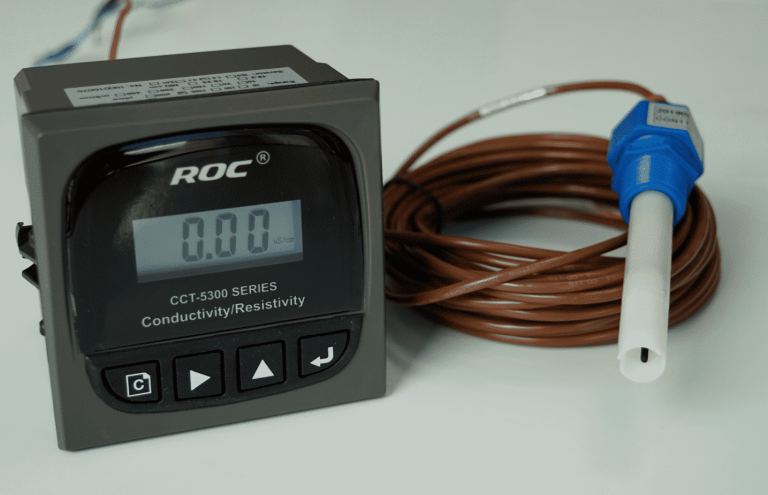
Shanghai ChiMay’s four-electrode in-line conductivity probe with a 0.01 cm⁻¹ cell constant resolves this range comfortably. Because the transmitter supports multi-tier alarms, an advisory alert can fire at 0.065 μS/cm and a warning at 0.080 μS/cm without needing extra PLC logic. Catching this drift early keeps sodium and chloride breakthrough from reaching the batching tanks and gives the water plant a full shift to schedule a resin swap on planned time rather than in emergency mode.
Alarm 2: Sudden Spike After a Storage Tank Turnover
A different pattern shows up on the UPW distribution header after a storage tank refill or a valve realignment. Conductivity does not drift; it jumps. A sudden step change of 0.02–0.10 μS/cm usually points to trapped water in a dead leg being pushed back into the main loop, or a valve that let a small volume of lower-quality service water into the header.
Shanghai ChiMay transmitters log these events with sub-second time stamps, which makes root cause analysis feasible after the fact. Operators frequently pair the conductivity trend with valve position feedback from the DCS and identify the offending valve within minutes rather than after a day of investigation. Once the source is fixed, a dead-leg flush protocol prevents the same spike from recurring.
Alarm 3: Correlated Drift Across Two Sensors on the Same Header
Single-sensor drift is often mistaken for a genuine water quality event. Two sensors on the same header drifting together is much more meaningful and points either to a real conductivity change in the process or to a synchronized calibration issue.
Shanghai ChiMay’s recommended redundancy layout puts two independent conductivity probes on the polishing outlet header. When the DCS calculates a correlation between the two signals in real time, alarms only fire when both probes agree. False alarms drop, and operator confidence in the data goes up. Cross-comparison also exposes a single-probe drift over months—if one probe starts running consistently 0.005 μS/cm higher than the other, the maintenance team knows exactly which one to service without pulling both.
Alarm 4: Nightly Trend Reversal at Low Consumption Hours
Overnight and weekend load reductions produce a distinctive signature on many UPW systems. Consumption drops, recirculation velocity falls, and conductivity begins a slow climb that reverses when production resumes. This pattern is a fingerprint of stagnant water in downstream distribution and often signals developing biofilm or a passive corrosion event in a dead leg.
Shanghai ChiMay conductivity trend data, layered against the plant flow record from a Turbine Flow Meter on the return header, reveals this pattern within a week of first appearing. Corrective actions typically involve rebalancing the recirculation loop or adjusting the sanitization schedule so that low-flow periods do not compromise water quality. The alarm strategy here is not a single set point but a shape-based rule: “conductivity rise above 0.010 μS/cm during zero-consumption hours.”
Alarm 5: Post-Sanitization Recovery Overshoot
Every UPW system undergoes periodic hot-water or ozone sanitization. During and immediately after these events, conductivity behaves in predictable ways—rising slightly during the sanitization and returning to baseline as the loop flushes. An overshoot on the return to baseline is a warning that something has changed in the polishing chain: often a leached impurity from a resin bed or a piping change that has released ionic material.
Shanghai ChiMay transmitters allow operators to time-stamp sanitization events and automatically compare the recovery curve against the previous three cycles. When a return-to-baseline conductivity is 15 percent higher than the moving average, the transmitter fires a “sanitization anomaly” alarm. Yield engineers value this catch because a compromised sanitization can silently degrade water quality for weeks before showing up in cell formation yield data.
Why Conductivity Wins as the First-Line Signal
Conductivity earns its front-line position because it is fast, cheap to instrument redundantly, and correlates with a wide range of contamination classes. It will not distinguish between sodium and chloride, and it does not see silica or TOC directly, but for the majority of UPW failure modes it moves before any other online signal.
Shanghai ChiMay’s approach is to instrument conductivity everywhere it can drive an operator decision, then layer TOC, silica, and DO measurements on top for the specific contamination classes that conductivity cannot see. That order of investment—conductivity first, then specialty analyzers—is the fastest path to a resilient UPW loop.
Integration and Operator Experience
Reading these alarms only matters if the data reaches the right operator quickly. Every Shanghai ChiMay transmitter supports Modbus RTU/TCP and 4–20 mA outputs, so integration into any existing DCS or historian is a straightforward exercise. Alarms can be routed to control room displays, mobile notifications, or the plant’s larger MES system as needed.
Operator training is deliberately kept simple. All Shanghai ChiMay conductivity transmitters share the same menu structure and calibration workflow, which means a technician trained on one probe is functionally trained on the whole loop. This lowers the learning curve during startup and keeps mean time to repair short when an alarm does fire.
The Financial Case for Better Alarms
Skeptical CFOs sometimes ask whether alarm-tier granularity justifies the additional transmitter cost. The answer, in most gigafactories that have run the numbers, is yes. A single avoided cell formation excursion, or a single avoided week of degraded coating yield, typically pays back the incremental sensor investment in the same quarter it is deployed. Conductivity analyzers are inexpensive compared with the process they protect, and the alarms they surface are among the highest-leverage instruments in the plant.
Takeaway for UPW Engineers
Battery-grade UPW does not fail all at once. It fails slowly, in patterns that a well-instrumented conductivity system will see days or weeks before anyone else notices. Shanghai ChiMay conductivity analyzers are designed to sit at the front of that early-warning stack. For UPW engineers building a resilient water strategy in 2026, the five alarm patterns above are the first place to invest, and they are the first place a Shanghai ChiMay-based instrumentation plan pays back.