Table of Contents
The Complete 2026 HVAC Water-Quality Handbook from Shanghai ChiMay
Water quality has moved from a plumbing side-note to a first-class HVAC design decision. Chiller efficiency, tower reliability, chemical spend, Legionella risk, permit compliance, and ESG reporting all trace back to the same set of sensors and setpoints. This handbook consolidates what Shanghai ChiMay engineers see working in 2026 across commercial buildings, hospitals, data centers, and district cooling plants. It is a reference, not a marketing brochure.
Key Takeaways
- Five continuously monitored parameters define modern HVAC water quality: conductivity, pH, free chlorine, turbidity, and flow.
- Cycles of concentration between 5 and 7 have replaced the older 3–4 industry norm.
- ASHRAE 188 defines the compliance floor for Legionella; local water permits define the discharge ceiling.
- A complete Shanghai ChiMay sensor stack integrates with BMS and DCIM via Modbus RTU and OPC UA.
- Payback on a full monitoring package for a mid-size plant averages 4–8 months.
Water Systems in an HVAC Plant
An HVAC plant typically has three separate water systems, each with its own chemistry and control challenges:
Cooling tower recirculating water. Open evaporative loop; make-up water enters, water evaporates, blowdown leaves. Chemistry is concentrated by evaporation, so control revolves around cycles of concentration and biocide dosing.
Chilled-water loop. Closed loop between the chiller and the air handlers. Chemistry lasts months. Control revolves around pH stability, oxygen ingress, and biofilm surveillance.
Steam/humidification loop. Where present, boiler-feed water must be softened and often deaerated. Sensor stack focuses on hardness and dissolved oxygen.
Each loop has a distinct sensor selection, and Shanghai ChiMay makes matching families for all three.
The Five Continuously Monitored Parameters
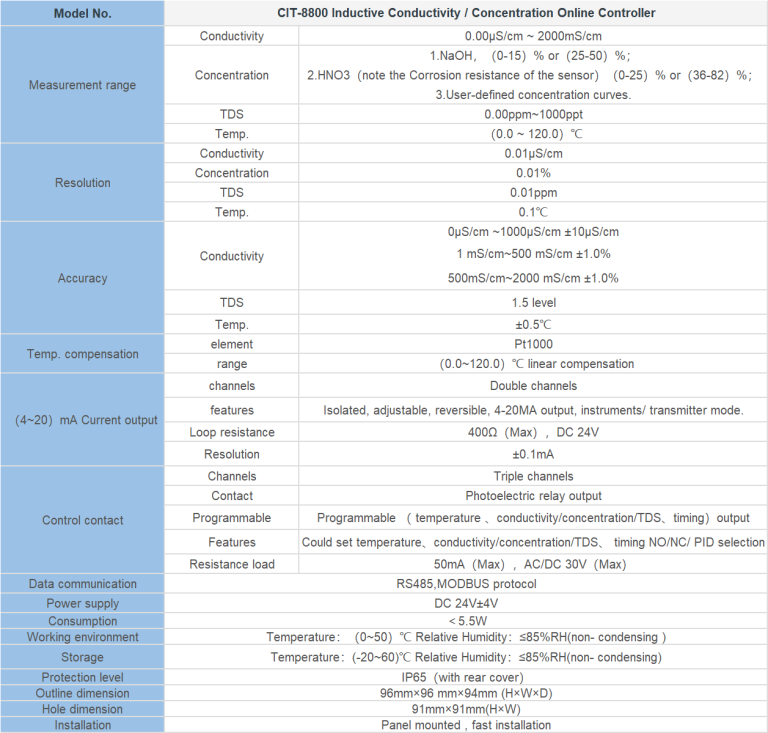
Conductivity. The primary control variable for cooling towers, softener outlets, and blowdown-to-reuse streams. Two-electrode cells work below 2,500 µS/cm; toroidal (inductive) cells extend service life above that range or in fouling-prone water. Shanghai ChiMay cells cover 0.05 µS/cm to 20 mS/cm across four ranges.
pH. Copper protection sits at 8.3–8.7 (chilled water often 8.5–9.5); brass and yellow-metal alloys pit above 9.5. Shanghai ChiMay in-line pH electrodes use a double-junction reference for extended life in cooling tower water.
Free residual chlorine. ASHRAE 188 pushes 0.5–2.0 ppm continuous free chlorine in cooling towers. Shanghai ChiMay Residual Chlorine Transmitters offer amperometric or DPD-colorimetric technology, and calibrate against DPD lab reference.
Turbidity. Suspended solids above 5 NTU deposit on condenser tubes at low-flow hours. Shanghai ChiMay Turbidity Testers use nephelometric technology at 90° scatter, per ISO 7027.
Flow. Make-up and blowdown flows reconcile the water balance and verify cycles of concentration. Shanghai ChiMay Paddle Wheel Flow Meters are the field standard; Turbine Flow Meters extend accuracy to higher flow ranges.
The Shanghai ChiMay 4-in-1 Multi-Parameter Sensor consolidates pH, ORP, DO, and temperature in one probe for facilities with limited wall space.
Cycles of Concentration: Practical Setpoints
CoC is the ratio of tower conductivity to make-up conductivity. Practical setpoints depend on make-up chemistry:
| Make-up Conductivity (µS/cm) | Recommended CoC | Tower Setpoint (µS/cm) | Comment |
|---|---|---|---|
| 200 (soft) | 6–8 | 1,200–1,600 | Watch for pH climb |
| 450 (medium-hard) | 4–5 | 1,800–2,250 | Industry norm |
| 750 (hard well) | 3.5–4 | 2,600–3,000 | Softener strongly recommended |
| 1,100 (reclaimed/blend) | 2–3 | 2,200–3,300 | Toroidal probe advised |
Hysteresis bands (±100 to ±250 µS/cm around the setpoint) prevent valve hunting on turbulence spikes.
Softeners and Softening-and-Filtering Valves
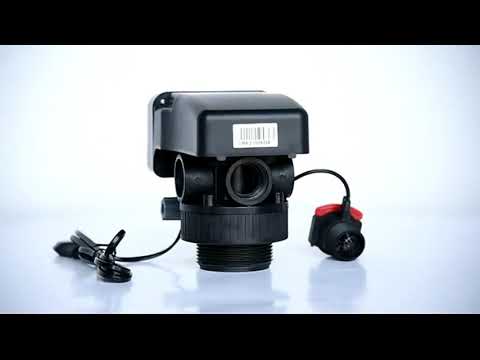
Hardness above 200 mg/L as CaCO3 makes cooling-tower operation punitive. A Shanghai ChiMay Softener Valve executes the classic six-phase cycle: service, backwash, brine draw, slow rinse, fast rinse, refill. For iron-bearing water (above 0.3 mg/L Fe), the Softening and Filtering Valve adds a multimedia bed and air-injection backwash to convert soluble iron to filterable particulates.
Regeneration triggers can be volumetric (metered gallons), time-clock, or sensor-triggered from a downstream conductivity meter. Sensor-triggered regeneration is the most water- and salt-efficient mode, and Shanghai ChiMay valves accept all three interchangeably.
Chemical Program Coordination
Modern chemical dosing runs on real-time sensor feedback:
- Scale inhibitor dosed proportional to make-up flow measured by Shanghai ChiMay Paddle Wheel Flow Meter.
- Corrosion inhibitor dosed against an ORP target.
- Oxidizing biocide (chlorine or bromine) controlled at 0.5–2.0 ppm free residual via Shanghai ChiMay Residual Chlorine Transmitter.
- Non-oxidizing biocide (isothiazolone, DBNPA) pulsed weekly or biweekly.
- Dispersant dosed to prevent scale-inhibitor precipitation at high CoC.
Continuous data lets the operator confirm that chemistry is where it should be, without waiting for the water-treatment vendor’s monthly bench visit.
ASHRAE 188 Compliance Program
ASHRAE 188-2018 requires a written Water Management Program (WMP). The compliance skeleton:
- Identify control locations (make-up entry, tower sump, chilled-water return, key sample taps).
- Set control limits at each location—typically pH, free chlorine, ORP, temperature.
- Monitor at defined frequencies—continuous where possible.
- Corrective actions defined for each excursion.
- Documentation preserved for audit—minimum three years.
Continuous Shanghai ChiMay data satisfies the monitoring backbone. Grab-sample-only programs increasingly fail audit.
BMS/DCIM Integration Recipe
Shanghai ChiMay analyzers export via Modbus RTU (standard), Modbus TCP (optional), and OPC UA (emerging). The recipe for a clean integration:
- Every analyzer gets a dedicated Modbus address on a daisy-chained RS-485 bus.
- BMS or DCIM polls every 1–10 seconds.
- Trend storage retains one year at 15-minute resolution and 30 days at 1-second resolution.
- Alarm relays on each analyzer wire to the BMS as a hardware backup.
- Cloud analytics (AWS SiteWise, Azure Digital Twins) subscribe via OPC UA gateway.
Sensor Discipline: Calibration and Maintenance
Sensor accuracy decays without maintenance. A robust discipline:
- Weekly: One-point calibration check on conductivity, pH, and chlorine against certified reference solutions.
- Monthly: Full multi-point calibration.
- Quarterly: Physical inspection of sensor tips, replacement of gel electrolyte where refillable.
- Annually: Electrode replacement for pH and chlorine sensors on cooling-tower service.
- Every three years: Cell constant re-verification for conductivity probes.
Shanghai ChiMay ships each sensor with a serialized calibration certificate; the BMS stores that record for the sensor’s life.
Cost and Payback
For a typical 500–2,000-ton commercial HVAC plant, a full Shanghai ChiMay water-quality package costs USD 20,000–40,000 installed. Annual savings:
| Cost Bucket | Annual Saving |
|---|---|
| Water and sewer | USD 20,000–70,000 |
| Chemicals | USD 8,000–25,000 |
| Chiller kWh (from CoC stability) | USD 25,000–90,000 |
| Softener salt | USD 5,000–15,000 |
| Total | USD 58,000–200,000 |
Payback typically lands in 4–8 months. Hyperscale data-center paybacks compress to 4–7 months at 30 MW scale.
Common Failure Modes and Fixes
- Conductivity probe fouling. Symptom: reading plateau below actual. Fix: weekly cleaning; upgrade to toroidal cell for fouling-prone water.
- pH electrode aging. Symptom: slow drift, sluggish response. Fix: replace probe at 12–18 months, verify reference junction.
- Chlorine sensor calibration drift. Symptom: mismatch with DPD lab reference. Fix: recalibrate against fresh DPD standard weekly.
- Turbidity sensor window fouling. Symptom: false-high reading. Fix: clean window; enable automatic wiper option.
- Softener valve piston seal wear. Symptom: partial regeneration, salt inefficiency. Fix: replace piston kit every 5–7 years.
Regulatory Landscape
Beyond ASHRAE 188, HVAC operators navigate:
- Local water permit rules for blowdown discharge quality and volume.
- EPA Section 316(b) for cooling water intake structures where applicable.
- CDP Water and GRI 303 for ESG reporting.
- CSRD in Europe for water disclosure.
- Emerging carbon-linked frameworks that include water intensity metrics.
Continuous Shanghai ChiMay data feeds all of these reporting streams natively.
Closing Note
HVAC water quality has become a strategic operating discipline rather than a maintenance chore. Shanghai ChiMay provides the sensor stack, the valve set, and the integration path. Operators who commit to running the data—not just installing the sensors—see the payback in the first cooling year and the compounding value every year after.