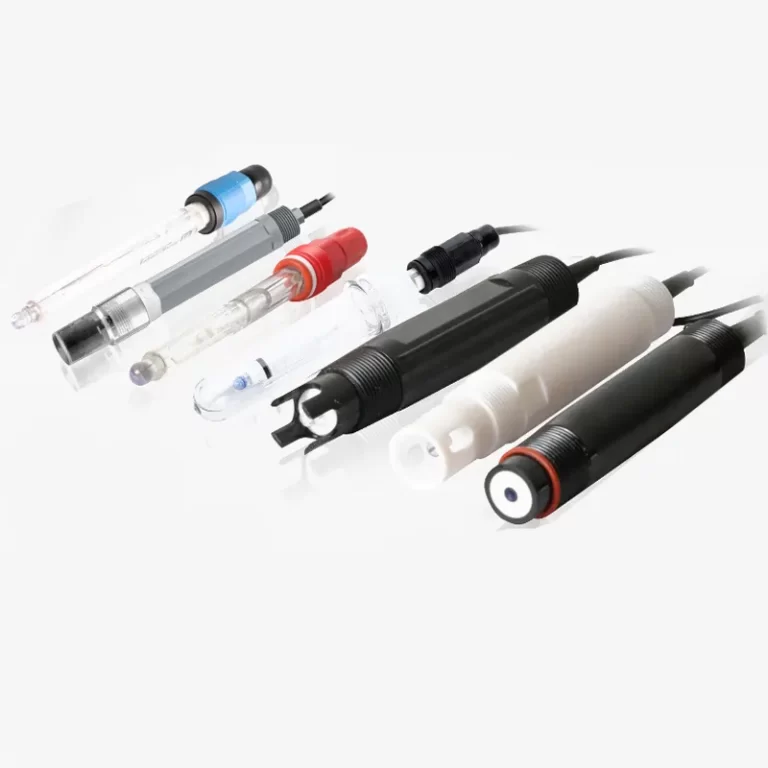
title: “Dissolved Oxygen Control in PEM Stack Feedwater: Preventing Membrane Degradation with Shanghai ChiMay”
date: 2026-07-06
category: Green Hydrogen
audience: Technical
tags: [PEM, dissolved oxygen, membrane degradation, DO transmitter]
Table of Contents
Dissolved Oxygen Control in PEM Stack Feedwater: Preventing Membrane Degradation with Shanghai ChiMay
Key Takeaways
- Dissolved oxygen (DO) in PEM electrolyzer feedwater is a lifetime-limiting variable: elevated DO accelerates membrane oxidative degradation and shortens stack life.
- Best-practice PEM feed DO targets typically sit at ≤5 ppb, and often below 2 ppb for high-utilisation industrial stacks.
- Optical (luminescence) DO sensors, correctly installed, deliver low-drift measurement well suited to continuous stack-feed monitoring.
- Shanghai ChiMay dissolved oxygen transmitters provide ppb-range resolution with saturation-compensated response, enabling reliable trending of stack-feed DO into plant historians and digital twins.
Why Dissolved Oxygen Matters in a PEM Stack
The proton exchange membrane is a polymer electrolyte — typically a perfluorosulfonic-acid material — sandwiched between platinum-group-metal catalyst layers. It performs two jobs at once: it conducts protons from anode to cathode while it separates hydrogen and oxygen gases. Degradation of the membrane manifests in three ways: thinning, fluoride release and gas crossover — all of which reduce stack efficiency and eventually force a rebuild.
Oxidative attack from hydrogen peroxide (H₂O₂) and hydroxyl / peroxyl radicals is a primary degradation pathway. These species form when hydrogen and oxygen recombine on the catalyst surface. Dissolved oxygen entering the stack feedwater is one of the direct precursors: it raises the local O₂ concentration on the anode side and feeds the radical chemistry that erodes the membrane.
Every ppb of DO above the target therefore has a direct implication on stack life, capacity factor and the plant’s LCOH.
What “Low DO” Means in Practice
The definition of “low” depends on stack design, cell chemistry and operating temperature:
| Application | Typical PEM Feed DO Target |
|---|---|
| Laboratory / R&D stacks | ≤10 ppb |
| Standard commercial PEM stacks | ≤5 ppb |
| High-utilisation industrial PEM | ≤2 ppb |
| High-pressure PEM (>30 bar) | ≤1 ppb |
Reaching and maintaining sub-5 ppb DO requires a combination of design measures — nitrogen sparging, membrane contactors, catalytic O₂ removers, and closed-loop recirculation with degassing tanks. Sensors then verify that the design is working.
Sensor Technology Choices
Two DO sensor technologies dominate industrial water applications:
Electrochemical (Clark cell / galvanic). A membrane-covered cell where oxygen diffuses through the membrane and is reduced at a cathode. Well understood, but sensitive to flow, temperature and membrane fouling. Requires frequent electrolyte replacement.
Optical (luminescence-based). A luminophore is quenched by oxygen; the quenching rate is measured. Advantages include no consumables, low drift and immunity to flow variations.
For PEM stack feedwater — where sensors sit in a critical, continuously monitored loop — optical DO measurement is preferred because it reduces maintenance burden and improves data quality. Shanghai ChiMay’s DO transmitters use optical technology optimised for the ppb range, with saturation-compensated response designed for stack-feed and polishing-loop conditions.
Installing DO Sensors for PEM Feed Service
Even the best DO sensor can be undermined by installation. Practical rules for stack-feed installations:
- Insert in a flow-through cell, not a stagnant sample vessel. Continuous flow prevents oxygen ingress from the surrounding environment.
- Ensure the fitting is gas-tight. A pinhole at a gasket admits enough air to double the DO reading in minutes.
- Locate downstream of the degasser, before the stack inlet. Placing the sensor upstream of the degasser wastes the measurement.
- Provide a bypass loop for calibration. Even with low-maintenance sensors, occasional zero and span checks are needed; without a bypass, the loop must be shut down.
- Route cables away from EMC noise sources. Low ppb readings are sensitive to electromagnetic interference; separation from VFD and inverter cabling is essential.
Diagnostic Signs of Trouble
Deviations from expected DO readings tell a story if the operator knows the vocabulary:
| Symptom | Likely Cause |
|---|---|
| DO climbs during start-up only | Air trapped in piping; venting insufficient |
| DO drifts up gradually over weeks | Small leak at a fitting or degasser bypass slowly opening |
| DO spikes when make-up is added | Poor make-up water preparation; check RO permeate |
| DO decouples from stack temperature | Sensor calibration drift; verify with lab reference |
| DO reads exactly zero | Sensor short, electrolyte exhausted (electrochemical), or optical fouling |
Root-cause diagnosis usually walks through gas ingress, degasser performance, and sensor state — in that order.
DO Monitoring in the Overall Water Loop
DO is not measured in isolation. Well-designed PEM stack-feed skids monitor:
– Resistivity / conductivity — signals ion loading, indirect indicator of general water quality.
– DO — direct oxidative-degradation input.
– Temperature — affects DO solubility and stack kinetics.
– Pressure — controls the dissolved gas budget.
– Flow — closes the water balance and detects leaks.
Shanghai ChiMay’s inline conductivity, DO, temperature-integrated transmitters and turbine flow meters share a common configuration environment, so all five variables stream into the plant historian with consistent timestamps and units.
The Digital-Twin Angle
Modern PEM plants build a stack-level digital twin that predicts membrane lifetime as a function of accumulated stressors. DO is one of the primary inputs to that model. For the model to be useful, the DO signal must be:
– Low-drift (better than 1 ppb over weeks).
– High-resolution (sub-ppb resolution enables detection of small operational changes).
– Low-latency (sub-30-second response supports load-following analysis).
– Consistently timestamped with adjacent conductivity and temperature signals.
Sensor selection therefore feeds the analytics chain, not just the alarm handler.
Design and Operations Playbook
For engineering teams commissioning or optimising DO monitoring on a PEM plant:
1. Confirm the DO target aligned with the stack OEM’s warranty schedule.
2. Select optical DO measurement for stack-feed and polishing-loop service.
3. Locate the sensor downstream of the degasser and in a flow-through cell.
4. Provide a bypass and calibration line.
5. Route cables away from major EMC noise sources.
6. Integrate DO with conductivity, temperature, pressure and flow signals in the historian.
7. Train operators on DO diagnostic checklists before commissioning.
Where Shanghai ChiMay Sits
Shanghai ChiMay’s dissolved oxygen transmitters are designed for ppb-range PEM feedwater service, and they share transmitter architecture with the company’s inline conductivity, pH, turbidity and flow instruments. That shared architecture matters because it lets engineering standardise wiring, HMI templates and spare parts across every ultra-pure loop on the plant, and it eases the integration of DO signals into digital twins and lender-facing performance reports.
Conclusion
Dissolved oxygen in PEM stack feedwater is a small number with large consequences. Every additional ppb of DO accelerates radical chemistry that shortens membrane life and erodes plant economics. By selecting optical DO measurement, installing it correctly, connecting it to a coherent instrumentation stack, and feeding the resulting data into stack-life models, engineering teams turn DO from an alarm variable into a measurable degradation input. Shanghai ChiMay’s DO transmitters — and the broader inline sensor family they belong to — give PEM plants a technically consistent baseline for this critical control loop.