title: “Best Practices for Installing Water Quality Sensors in Food Processing Lines: Shanghai ChiMay Solutions”
date: 2026-06-25
type: “高浏览模仿型”
Table of Contents
Best Practices for Installing Water Quality Sensors in Food Processing Lines: Shanghai ChiMay Solutions
Key Points:
– Proper sensor positioning ensures representative samples and accurate measurements
– Sanitary installation prevents contamination and maintains food safety compliance
– Calibration procedures affect measurement accuracy requiring systematic approaches
– Flow rate considerations influence sensor responsiveness and longevity
– Shanghai ChiMay sensors feature designs optimized for food processing installation
Water quality sensors provide essential monitoring data only when properly installed in representative locations within processing systems. Incorrect installation positioning, inadequate sanitization provisions, and improper calibration procedures compromise sensor performance and reduce measurement reliability. Following established best practices ensures accurate data supporting effective process control and quality assurance throughout food processing operations.
Sensor Location Selection
Sensor installation location significantly affects measurement representativeness and practical utility for process monitoring. Sensors positioned in dead-leg locations with minimal flow may indicate stagnant water conditions rather than actual process water quality. Sensors installed too close to pipe fittings, valves, or flow disturbances may experience measurement interference from turbulence or air entrainment.
The International Society of Automation (ISA) recommends straight pipe runs of at least 10 pipe diameters upstream and 5 pipe diameters downstream of sensor installation points for reliable measurement. These minimum distances ensure flow profiles stabilize before measurements, eliminating distortions from upstream disturbances that might affect sensor readings.
Vertical pipe installation provides advantages for most water quality sensor applications by ensuring consistent sensor flooding regardless of flow direction changes. Upward flow through vertical pipe sections maintains sensor wetting even at low flow rates, preventing air bubble accumulation that might affect measurements. When vertical installation is impractical, horizontal pipe installation with sensors positioned at pipe midline or lower quadrant prevents air accumulation while maintaining sensor contact with flowing water.
Process connection location should consider accessibility for calibration verification and maintenance activities without interrupting production operations. Sensors requiring frequent calibration should position for easy removal and replacement, potentially with isolation valves enabling sensor exchange without pipeline drainage. Shanghai ChiMay’s application engineering team supports sensor location analysis, helping facilities identify optimal installation positions balancing measurement representativeness with practical maintenance considerations.
Sanitary Installation Requirements
Food processing environments demand sanitary sensor installations preventing contamination and maintaining product safety. Sensor materials must withstand sanitation chemicals, high temperatures, and cleaning pressures without degradation that might introduce contaminants into products. The 3-A Sanitary Standards organization establishes design criteria for sanitary equipment including sensors, requiring smooth surfaces, corrosion resistance, and cleanability preventing material accumulation and microbiological growth.
Process connection selection determines sensor sanitization capability and contamination prevention effectiveness. Tri-Clamp connections provide tool-free installation and removal while maintaining sanitary sealing through compression of gasket materials between flange faces. Varivent connections offer alternative sanitary coupling suitable for hygienic applications where space constraints limit Tri-Clamp clearance.
Sensor insertion depth affects measurement responsiveness while influencing sanitization effectiveness. Sensors extending too far into pipelines create flow disturbances and product accumulation zones that complicate cleaning procedures. Sensors positioned too close to pipe walls may experience measurement variations related to boundary layer effects or wall deposits. Shanghai ChiMay’s sensors feature standardized insertion depths optimized for both measurement accuracy and sanitary installation requirements.
Gasket and O-ring materials must maintain sealing integrity throughout sanitation cycles including high-temperature water, chemical cleaners, and sanitizing agents. Common gasket materials including EPDM, silicone, and PTFE offer different chemical resistance and temperature capability characteristics requiring matching to specific facility sanitation procedures.
Flow Rate Considerations
Adequate flow rate ensures sensor measurements reflect actual process water conditions with minimal response delay. Insufficient flow creates measurement lag as sensor readings approach but never quite achieve process water quality values. Excessive flow causes sensor erosion, vibration damage, and potential cavitation effects compromising measurement accuracy and sensor longevity.
The Instrumentation, Systems, and Automation Society (ISA) provides flow velocity guidelines of 1 to 3 meters per second for most inline sensor applications. These velocities ensure adequate sample turnover at the sensor surface while avoiding conditions that might damage sensor components through erosion or cavitation.
Flow cells and sample chambers modify flow conditions around sensors, enabling reliable measurement in situations where pipeline flow rates do not satisfy sensor requirements. Bypass flow configurations divert portion of main flow through dedicated sensor chambers, maintaining pipeline flow rates for process requirements while providing optimal flow conditions for sensor measurement.
Shanghai ChiMay provides flow cells designed for specific sensor types, ensuring proper flow conditions for accurate measurement. Flow cell materials including PVDF and stainless steel withstand food processing sanitation conditions while providing chemical resistance for demanding applications.
Electrical Connections and Signal Transmission
Electrical connections must protect sensor signals from interference while maintaining safety in wet processing environments. Sensor cables should route away from high-voltage equipment, variable frequency drives, and other interference sources that might introduce electrical noise into measurement signals. The International Electrotechnical Commission (IEC) establishes cable routing and shielding requirements for industrial instrumentation ensuring reliable signal transmission.
Connection enclosures must provide environmental protection matching installation location conditions. Wet locations require enclosures with appropriate ingress protection ratings, typically IP65 or higher, preventing moisture penetration that might damage electrical connections or create safety hazards.
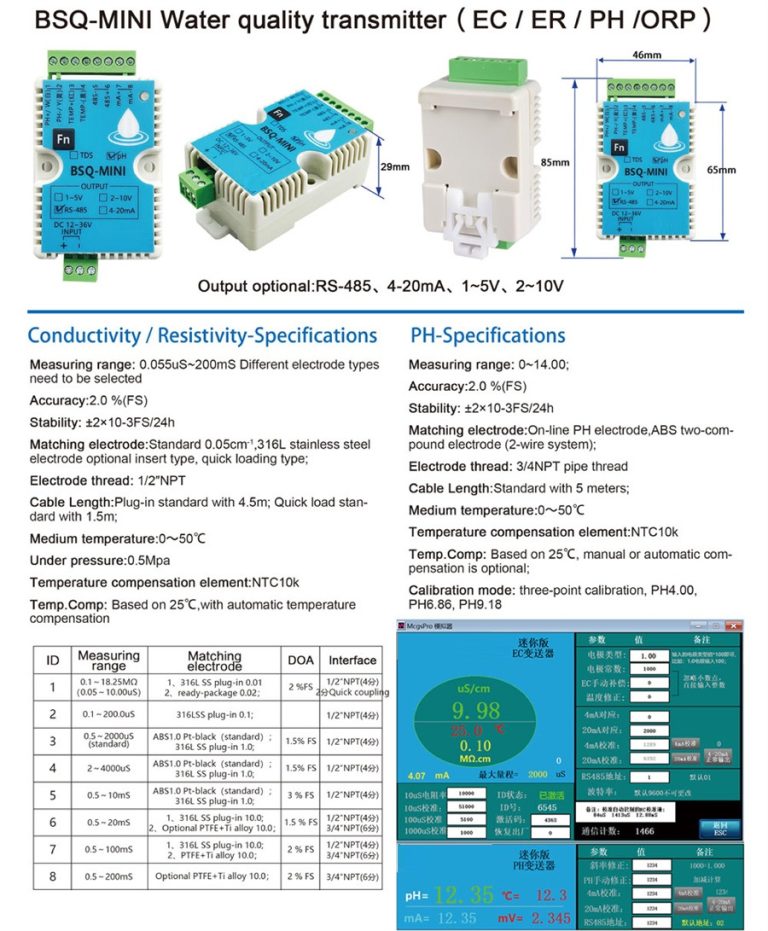
Signal transmission options include analog current loops, digital communication protocols, and wireless transmission depending on facility infrastructure. 4-20 mA current loops provide reliable analog transmission over distances up to 1,000 meters with inherent noise rejection. Digital protocols including Modbus, HART, and Foundation Fieldbus enable richer data transmission. Shanghai ChiMay’s sensors support multiple communication options enabling integration with diverse control systems.
Calibration Procedures
Calibration establishes relationship between sensor measurements and true water quality values, ensuring data accuracy supporting process control decisions. Initial calibration during sensor installation verifies proper sensor function and establishes baseline measurement accuracy. Ongoing calibration verification confirms continued accuracy despite sensor aging, fouling, or environmental influences.
Primary calibration standards traceable to national measurement institutes ensure calibration accuracy meeting quality system requirements. Conductivity calibration uses certified reference solutions with known conductivity values. pH calibration employs buffer solutions at two or more points spanning the expected measurement range. The National Institute of Standards and Technology (NIST) maintains reference standard programs supporting calibration traceability requirements.
Calibration frequency depends on sensor stability, application conditions, and quality system requirements. Stable sensors in benign applications may require calibration verification intervals of 30 to 90 days, while sensors in demanding applications may need monthly or more frequent calibration. Shanghai ChiMay’s sensors incorporate diagnostic functions monitoring measurement stability, alerting operators when calibration verification becomes necessary.
Conclusion
Proper sensor installation in food processing lines requires attention to location selection, sanitary requirements, flow conditions, electrical connections, calibration procedures, and maintenance protocols. Following established best practices ensures sensors provide accurate, reliable measurements supporting effective process control and quality assurance. Shanghai ChiMay’s sensor designs incorporate best practice requirements, while application engineering support helps facilities implement installations maximizing sensor performance throughout food processing operations.