Table of Contents
Why Does Seawater Desalination Need Real-Time Monitoring? Solutions from Shanghai ChiMay
关键要点:
– Real-time monitoring enables immediate detection of membrane fouling, typically reducing performance by 15-30% before visible symptoms appear
– Continuous conductivity measurement can identify salt rejection drops below 98% within minutes, preventing hours of substandard product water
– Automated monitoring reduces manual sampling labor by 60-80% while improving data quality and consistency
– Shanghai ChiMay’s monitoring solutions provide continuous 24/7 surveillance with alert capabilities for immediate operator notification
– Early problem detection through real-time monitoring can extend membrane lifespan by 20-25%, representing significant capital savings
– Investment in comprehensive monitoring typically delivers 10-15x return through improved operational efficiency
Introduction
Every day, desalination facilities worldwide transform billions of liters of seawater into freshwater for drinking, industry, and agriculture. Behind this transformation lies sophisticated membrane technology—but even the most advanced membranes require vigilant monitoring to deliver consistent performance. Real-time water quality monitoring has evolved from optional enhancement to essential operational requirement.
The global water scarcity challenge drives continuous expansion of desalination capacity, with facilities becoming larger, more complex, and more capital-intensive. In this environment, the ability to detect problems immediately—before they cascade into major failures—becomes critical to operational success. Manual sampling and periodic laboratory analysis simply cannot provide the real-time visibility that modern desalination demands.
The Stakes of Desalination Monitoring
Economic Impact of Inadequate Monitoring
Membrane replacement costs range from $300,000 to $2 million per large-scale installation, with replacement frequency directly tied to fouling management effectiveness. Facilities without continuous monitoring typically experience 30-50% shorter membrane lifespans compared to well-monitored operations. Beyond replacement costs, fouling-related performance losses increase energy consumption—each 10% reduction in membrane permeability demands approximately 5% more pump energy to maintain production rates.
The cumulative impact is substantial: a mid-sized desalination facility (100,000 m³/day capacity) might spend $2-4 million annually on energy alone. Even modest performance improvements from better monitoring translate to significant operational savings. Consider a facility achieving just 5% energy reduction through optimized operation enabled by real-time monitoring—at $0.10/kWh, this represents $100,000-200,000 annual savings for every 10,000 m³/day of production capacity.
Water Quality Implications
Product water quality affects everything from consumer health to industrial process compatibility. Substandard water can damage household appliances, compromise pharmaceutical manufacturing, or fail industrial cooling systems. Real-time monitoring provides the earliest possible detection of quality excursions—often before tank levels drop enough for system operators to notice through production metrics alone.
Regulatory compliance represents another critical dimension. Drinking water standards typically specify maximum conductivity levels, residual chlorine concentrations, and numerous other parameters. Continuous monitoring generates comprehensive compliance records while providing immediate notification when parameters approach regulatory limits.
Membrane Protection Economics
Membrane damage from scaling, fouling, or chemical attack often proves irreversible. Once polyamide membranes suffer oxidative damage from chlorine exposure, or once carbonate crystals embed permanently in membrane pores, replacement becomes the only solution. Each hour of undetected membrane damage potentially costs thousands of dollars in premature replacement and lost production.
Real-time monitoring transforms membrane protection from reactive response to proactive prevention. By tracking performance trends over time, operators identify gradual degradation before it becomes catastrophic. This predictive capability extends membrane life, reduces replacement frequency, and ensures consistent water quality throughout the operational life of each membrane element.
What Real-Time Monitoring Actually Measures
Conductivity: The Primary Indicator
Conductivity measurement serves as the cornerstone of desalination monitoring because it directly correlates with dissolved solid concentration. Salt rejection rates—calculated by comparing feed and product water conductivity—provide immediate indication of membrane integrity. A sudden increase in product water conductivity often signals membrane damage or failure, enabling rapid response before significant quality violations occur.
Continuous conductivity monitoring at multiple points throughout the treatment train reveals fouling patterns, pretreatment effectiveness, and membrane degradation trends. By tracking conductivity across the system—inlet, outlet, and intermediate stages—operators pinpoint problem locations and implement targeted remediation.
Shanghai ChiMay’s inline conductivity sensors provide the precision and stability required for these critical measurements, with accuracy specifications of ±1% of reading ensuring reliable performance assessment. The sensors feature integrated temperature compensation, fouling-resistant electrode designs, and multiple communication options for seamless control system integration.
pH and Oxidation-Reduction Potential
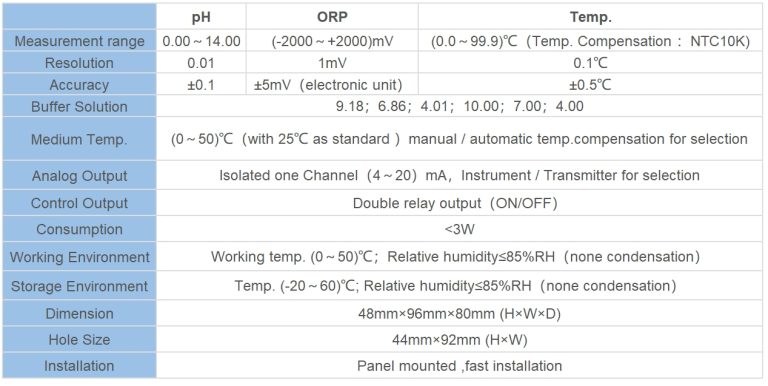
Acid-base chemistry drives scaling potential and cleaning efficiency. pH measurement enables optimization of chemical dosing for scale prevention while protecting membranes from overly aggressive treatment. The Langelier Saturation Index (LSI)—a key scaling prediction tool—relies heavily on accurate pH measurement to predict carbonate precipitation tendency.
Oxidation-reduction potential (ORP) monitoring tracks disinfectant residuals and detects corrosive conditions that threaten metal components throughout the treatment system. Maintaining appropriate ORP levels prevents both biological fouling from insufficient disinfection and membrane damage from excessive oxidant exposure.
Turbidity and Particle Monitoring
Suspended solids accelerate membrane fouling by physically blocking membrane pores and providing surfaces for biological attachment. Turbidity monitoring at the feed water inlet verifies pretreatment effectiveness—turbidity above 1 NTU typically indicates inadequate filtration that will shorten membrane life. Particle counters provide even more sensitive detection of pretreatment upsets, identifying submicron particles invisible to turbidity sensors.
Differential Pressure Monitoring
Rising differential pressure across membrane vessels provides the most direct indication of fouling accumulation. As biofilms grow, particles accumulate, and scale deposits form, flow resistance increases, manifesting as measurable pressure increases. Early detection through continuous differential pressure monitoring enables cleaning interventions before severe fouling requires aggressive chemical treatments or mechanical cleaning.
Benefits Beyond Problem Detection
Optimized Chemical Dosing
Continuous monitoring enables precise chemical dosing tied to actual water quality rather than conservative worst-case estimates. Antiscalant consumption represents $50,000-200,000 annually for medium-sized facilities—significant savings possible with optimized dosing based on real-time monitoring data.
pH-based acid dosing follows similar optimization opportunities. Rather than maintaining conservative pH setpoints that guarantee scaling prevention but waste acid, real-time monitoring enables dynamic adjustment based on actual water chemistry. When feed water alkalinity decreases following rainfall, acid dosing automatically reduces; when seasonal upwelling brings higher-calcium water, dosing increases proportionately.
Predictive Maintenance
Trend analysis reveals gradual changes that signal impending problems. A conductivity sensor showing 0.5% drift per month might indicate calibration drift or sensor degradation requiring attention. Membrane performance curves showing progressive permeability decline enable scheduling of cleaning or replacement before emergency shutdowns occur.
Predictive maintenance transforms maintenance from calendar-based scheduling to condition-based optimization. Rather than cleaning membranes on fixed schedules regardless of actual fouling, facilities clean when performance data indicates fouling accumulation. This approach reduces cleaning frequency for well-performing systems while ensuring timely intervention for challenging conditions.
Regulatory Compliance Documentation
Continuous monitoring generates comprehensive records demonstrating compliance with water quality standards. These records—far more valuable than periodic grab samples—provide legal protection and regulatory goodwill. When questions arise about historical water quality, continuous data provides defensible evidence of consistent compliance.
Some jurisdictions now require continuous monitoring for new permit approvals, making real-time systems essential for facility expansion. The investment in monitoring infrastructure often represents a small fraction of overall project costs while enabling regulatory approvals that unlock significant revenue potential.
Implementation Considerations
Sensor Selection Criteria
Reliable desalination monitoring requires sensors engineered for marine environments. Key selection criteria include corrosion resistance for chloride-containing atmospheres and high-salinity waters, fouling tolerance for biological and particulate accumulation, measurement accuracy for process control reliability, and communication protocol compatibility with existing control systems.
Shanghai ChiMay’s sensor lineup addresses each requirement with products ranging from basic conductivity cells to multi-parameter monitoring stations. The comprehensive product range enables single-source procurement while ensuring component compatibility.
Integration with Control Systems
Modern facilities utilize distributed control systems (DCS) or supervisory control and data acquisition (SCADA) systems for centralized monitoring. Sensors must communicate using standard protocols—HART, Modbus, or Foundation Fieldbus—enabling seamless integration. Wireless options reduce installation costs in retrofit applications where wiring proves impractical.
Shanghai ChiMay provides comprehensive integration support, including protocol converters and data loggers that bridge sensor networks with legacy control systems. The application engineering team assists with system design to ensure optimal data visibility and alarm management.
Redundancy and Backup
Critical monitoring points benefit from sensor redundancy—two instruments providing independent measurements eliminate single-point-of-failure risks. When one sensor requires maintenance, backup measurements maintain continuous surveillance. Some facilities implement triple-redundant monitoring for the most critical parameters, using voting algorithms to identify faulty sensors.
Redundancy costs must be balanced against failure consequences. For parameters affecting product quality or equipment protection, redundant sensors often prove cost-effective. For less critical monitoring points, single sensors with appropriate maintenance schedules may suffice.
Conclusion
Real-time water quality monitoring transforms desalination from reactive operation to proactive management. By detecting problems early, optimizing chemical usage, and providing compliance documentation, continuous monitoring delivers returns far exceeding its implementation costs.
Shanghai ChiMay’s monitoring solutions combine reliable instrumentation with practical installation expertise developed through years of desalination experience. Facilities implementing comprehensive monitoring programs consistently achieve better performance, longer membrane life, and lower operational costs—the definitive business case for real-time water quality monitoring.