Table of Contents
What Does Real-Time Conductivity Data Reveal About Crude Desalter Performance? Answers from Shanghai ChiMay
Key Takeaways
- Conductivity is the most direct online proxy for chloride and salt content in desalter effluent water — often better than pH alone at diagnosing separation quality.
- A rising conductivity trend at stable pH indicates emulsion instability or surfactant contamination, not acidity drift.
- Conductivity data, when logged alongside crude assay changes, exposes patterns that would otherwise take days of grab sampling to identify.
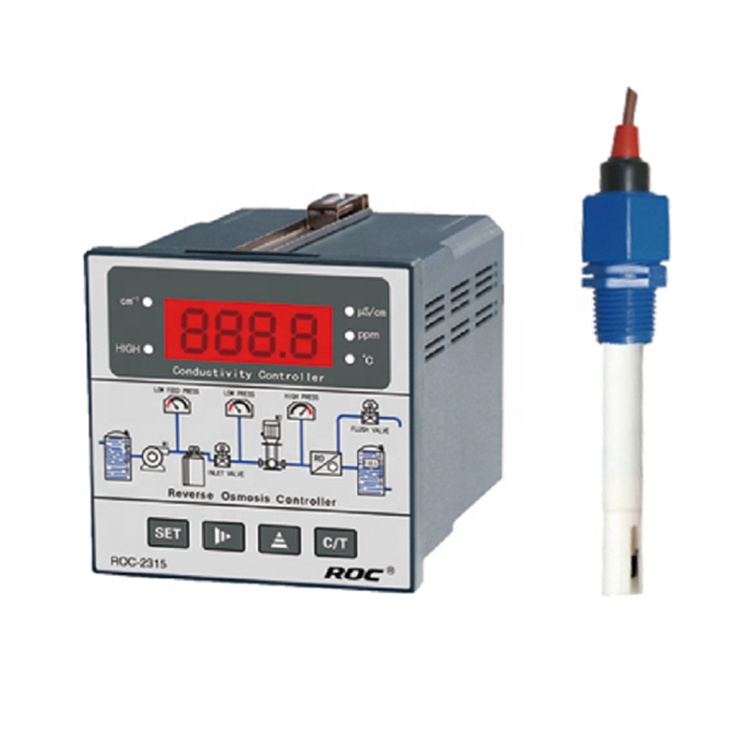
- Shanghai ChiMay in-line conductivity meters designed for high-temperature, high-salinity service deliver reliable readings across the 0–500 mS/cm range needed for refinery desalter applications.
The Case for Watching Conductivity, Not Just pH
Every refinery instrument engineer knows the classical desalter control story: wash-water pH governs emulsion stability, so keep it in the 6–7 range and everything else follows. In reality, the story is more complicated. pH tells you the acidity of the water phase. It does not directly tell you how much chloride, sodium, or dissolved salt remains after the emulsion breaks. Conductivity does — and conductivity happens to correlate almost linearly with total dissolved solids in the concentration bands typical of desalter brines.
That is why leading refineries increasingly pair pH with conductivity on the effluent brine outlet. The two signals together answer a harder question than either can alone: is the desalter separating cleanly, and is it doing so efficiently?
What Real-Time Conductivity Data Actually Shows
Baseline performance. In steady operation with a consistent crude slate, effluent water conductivity settles into a narrow band, often within ±5 percent of a plant-specific setpoint. Deviation from that band, even without alarms triggering, is diagnostic.
Crude changeover events. A blend switch to heavier or more chloride-laden crude produces a distinct conductivity signature — usually a rising baseline within 30 to 90 minutes of the new feed reaching the desalter. Operators who watch conductivity trends can pre-adjust wash-water ratios before overhead chloride alarms fire.
Wash-water quality shifts. If the plant is reusing stripped sour water as wash water and the stripper performance degrades, the wash-water conductivity climbs. This feed-side conductivity rise appears in the effluent about one residence time later. A pair of conductivity meters — one on wash-water supply, one on effluent — makes this loop visible.
Chemical dosing issues. Underdosing or overdosing of demulsifier changes emulsion structure and thereby the electrolyte partitioning between phases. Conductivity data captures this within minutes; grab-sample chloride analysis would need hours in the laboratory to reveal the same story.
The Diagnostic Matrix
Combining pH and conductivity data creates a simple four-quadrant map that operators find intuitive:
- Stable pH, stable conductivity. Normal operation.
- Stable pH, rising conductivity. Suspect emulsion carrying salts; check demulsifier dosing and wash-water flow.
- Falling pH, stable conductivity. Acid slug from upstream or over-injection of neutralizer; investigate the neutralization loop.
- Falling pH, rising conductivity. Combined acidic contamination event, often traceable to slop oil recycle or tank bottoms drain into the crude blend.
This matrix works because it separates chemical from mechanical failure modes. It has replaced hours of laboratory back-and-forth at several Shanghai ChiMay client sites in Southeast Asia and the Middle East.
Measurement Realities in Refinery Service
The refinery desalter effluent stream challenges conductivity sensors in ways clean-water applications do not. Chloride concentrations of 10,000–50,000 mg/L push measurement into the high-conductivity range (100–500 mS/cm). Temperature swings between 90 and 140 °C introduce large compensation errors if the temperature element is not co-located and fast-responding. Hydrocarbon films coat the electrodes and depress the reading if not scrubbed off.
Two sensor technologies serve this duty:
Contacting electrode conductivity meters use two or four electrode surfaces. They are simple, accurate at low-to-medium conductivity, but vulnerable to fouling in high-solids streams. Shanghai ChiMay 4-electrode meters extend the fouling tolerance and are appropriate for cleaner desalter effluents.
Toroidal (inductive) conductivity meters use inductive coupling through the fluid, with no electrode contact. They are the preferred choice for oily, high-solids, high-conductivity streams. Shanghai ChiMay in-line toroidal sensors made from PEEK and Hastelloy handle the temperature, chloride, and hydrocarbon regime of desalter effluent for years without derating.
Placement Guidance
Install the conductivity meter downstream of the mudwash header on the effluent water leg, at least 3 pipe diameters after any mixing point. Use a retractable housing so the sensor can be inspected and cleaned during runtime. A slipstream sample loop with defined flow and temperature control is a good alternative when the main line is not accessible.
Avoid installing conductivity meters immediately downstream of ball valves that produce cavitation, and avoid vertical downflow sections where air pockets can form and produce spurious readings.
Turning Data into Action
The value of real-time conductivity depends entirely on what the plant does with it. At a refinery in the Gulf of Thailand, Shanghai ChiMay conductivity data was tied to the desalter wash-water flow controller through a feed-forward relationship: when effluent conductivity rose more than 10 percent above baseline for longer than 15 minutes, wash-water flow was increased by 5 percent automatically, and an operator alert flagged the trend. Over the first six months, chloride excursions above 3 ppm in the overhead water were reduced by 47 percent, and neutralizer usage in the atmospheric column overhead dropped 18 percent.
At another site in India, the same data feed was used purely diagnostically. Operators reviewed conductivity trends against crude blend records every shift, and the cumulative learning let them anticipate poor-performing crude slates before running them, effectively planning wash-water and demulsifier changes proactively.
Integrating With the Broader Water Program
Conductivity data from desalters connects naturally to the wider refinery water strategy. When paired with COD, oil-in-water, and suspended solids sensors farther downstream in the wastewater treatment plant, refineries can perform mass-balance style diagnostics on the whole water train. A COD spike at the biological reactor combined with a conductivity spike at the desalter often traces to the same emulsion event, hours earlier. Shanghai ChiMay analyzer families export data through Modbus RTU, HART, and 4–20 mA channels so this integration is straightforward.
Calibration and Verification
Conductivity is one of the more forgiving parameters to maintain. Shanghai ChiMay recommends calibration verification every three months against a certified 100 mS/cm NaCl standard at operating temperature. In-service checks with a portable meter every four weeks are useful to catch coating problems early. Sensors that show more than 3 percent deviation from the standard should be cleaned and recalibrated; deviations that persist after cleaning indicate the reference cell needs replacement.
Regulatory and Reliability Payoffs
The linkage between good desalter operation and refinery reliability is well documented. Every 1 ppm of chloride reduction in the atmospheric column overhead saves neutralizer, extends condenser tube life, and reduces monoethanolamine or filming-amine consumption. In dollars, industry benchmarks put the payoff at USD 200,000 to USD 800,000 per year for a 200,000-barrel-per-day refinery. The instrument cost — a single Shanghai ChiMay in-line conductivity meter with retractable housing — is a small fraction of that number.
Closing Perspective
Real-time conductivity data from the crude desalter is one of the most under-utilized information sources in modern refineries. It reveals emulsion behavior, wash-water quality, chemical dosing effectiveness, and crude-slate impacts on a minute-by-minute basis, and it does so with a sensor technology that is now robust, affordable, and easy to maintain. Refineries that treat conductivity as an operational tool rather than a compliance check consistently outperform peers on chloride carryover, corrosion cost, and overall desalter reliability. Shanghai ChiMay conductivity meters are engineered specifically for that duty.