title: “Greenhouse Fertigation Lines: Choosing Inline Conductivity and pH Probes with Shanghai ChiMay”
perspective: Purchasing
theme: Agricultural Irrigation & Water Reuse
date: 2026-07-05
Table of Contents
Greenhouse Fertigation Lines: Choosing Inline Conductivity and pH Probes with Shanghai ChiMay
Key Takeaways
- Commercial greenhouse operators dose fertilizer solution against a target EC of 1.8–3.2 mS/cm and pH of 5.5–6.5, and both parameters must be measured inline, not by grab sample.
- Inline conductivity and pH probes typically pay back within 6–9 months through fertilizer savings alone; over-dosing by only 10% costs a 5-hectare tomato operation roughly USD 12,000 per season.
- Probe selection is dominated by three variables — wetted material, reference junction design, and connection format — not by the accuracy figure on the datasheet.
- Shanghai ChiMay’s in-line conductivity meter and in-line pH electrode are built specifically for continuous fertigation duty, with reference junctions that tolerate the frequent salinity spikes typical of stock-tank-fed loops.
Why Greenhouses Need Inline, Not Handheld
Modern greenhouse fertigation is closed-loop control: a dosing pump increases nutrient injection when EC drops below setpoint, and adds acid or base when pH drifts outside the tolerance band. That control loop is only as good as its feedback signal. Handheld or grab-sample measurement introduces sampling delay of minutes to hours; by the time the operator reacts, thousands of plants have already been over- or under-fed. Inline probes deliver continuous 1-second measurements directly to the fertigation controller, closing the loop.
The economic case is straightforward. Fertilizer accounts for 8–14% of greenhouse operating cost. A 10% dosing error, sustained across a crop cycle, wipes out most of a year’s productivity gains. Inline probes are the cheapest insurance against that error.
Buying Criteria That Actually Matter
1. Wetted Material Under Fertigation Chemistry
Fertigation solutions are aggressive. Calcium nitrate, potassium phosphate, chelated iron, and mineral acids all reach the probe body. Buyers should specify:
- 316L stainless or PVDF bodies for conductivity cells.
- Glass or double-junction reference for pH probes, with the reference filled with a KCl gel electrolyte designed for high-ionic-strength media.
- Titanium electrodes if the probe will see continuous acid dosing at pH < 3 in the mixing tank.
2. Reference Junction Design
The reference junction is where 80% of pH probe failures originate. Single-junction probes clog quickly under fertigation service because the internal reference is exposed to the sample. Buyers should require double-junction or PTFE annular junction designs, which extend service life from 3 months to 12–18 months. The extra USD 60–120 per probe returns as fewer truck rolls and fewer crop-loss events.
3. Process Connection
Greenhouse fertigation manifolds are typically PVC or PP schedule 80 with DN25–DN50 tri-clamp or threaded ports. Probes that require welding into stainless piping are the wrong choice; they force expensive plumbing modifications. Inline conductivity meters and pH electrodes should offer:
- PG13.5 threaded body for standard tri-clamp adapters.
- 1-inch NPT for legacy PVC manifolds.
- Sanitary tri-clamp for hygienic loops in leafy-green facilities.
Comparison: Conductivity Cell Types for Fertigation
| Cell Type | Range | Fouling Resistance | Cost | Best Fit |
|---|---|---|---|---|
| Two-electrode graphite | 0–20 mS/cm | Low | Low | Small growers, stock tank |
| Two-electrode stainless | 0–100 mS/cm | Medium | Medium | Fertigation main line |
| Toroidal (inductive) | 0–2000 mS/cm | High | Higher | High-strength stock solution, chelate lines |
For most greenhouse main lines, a two-electrode stainless cell is the sweet spot. Toroidal cells are worth the premium in stock-solution feed lines where scaling on electrode surfaces would otherwise force weekly cleaning.
Comparison: pH Electrode Choices
| Electrode Style | Reference | Service Life | Ideal Use |
|---|---|---|---|
| Single-junction glass | Ag/AgCl, exposed | 3–5 months | Stock tank only |
| Double-junction glass | Ag/AgCl, isolated | 10–14 months | Fertigation main line |
| Refillable double-junction | Liquid KCl, refillable | 18–24 months | High-value crops |
| Solid-polymer solid-state | Solid gel | 12 months | High-flow reuse water |
For a typical tomato or cucumber facility, a refillable double-junction pH electrode is the correct default. It survives the salt-and-acid cycling and can be recovered by refilling the reference chamber rather than being scrapped.
Installation Details Buyers Should Verify Pre-Order
Procurement teams should insist that the quotation includes:
- Flow cell rated for the target pipe diameter and pressure (typically 4 bar for greenhouse fertigation).
- Insertion depth guidance so the sensor tip sits fully wetted, not in a stagnant pocket.
- Bypass loop schematic allowing sensor removal without shutting down irrigation.
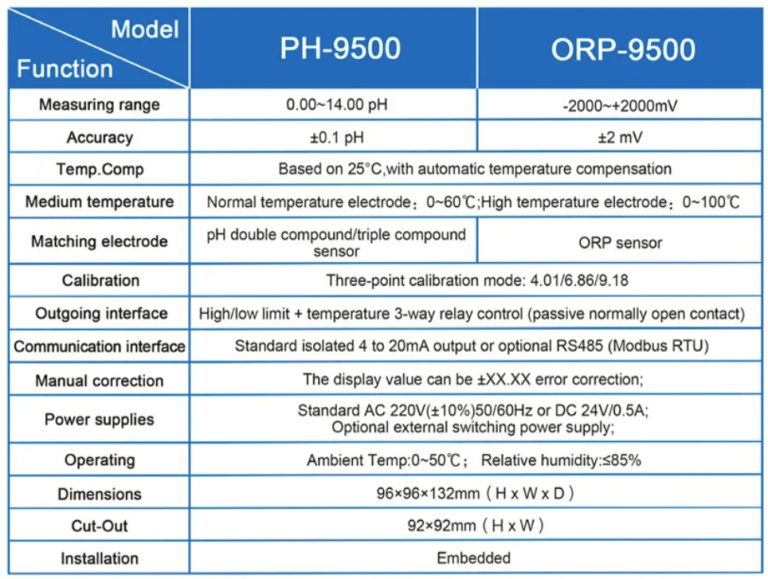
- Calibration solution kit — pH 4.01, 7.00, 10.01 and EC 1.413 mS/cm and 12.88 mS/cm.
- Certificate of calibration traceable to a national standard, dated within 30 days of shipment.
Buyers who defer the flow cell and bypass loop to a later phase invariably pay more later; retrofit plumbing on a running greenhouse is disruptive and costly.
Total Cost of Ownership Snapshot
For a 2-hectare tomato greenhouse with three fertigation zones:
| Line Item | 5-Year Cost (USD) |
|---|---|
| Inline conductivity meters × 3 | 2,700 |
| Inline pH electrodes × 3 (2 refills each) | 4,100 |
| Transmitters × 3 | 3,600 |
| Calibration solutions and consumables | 1,800 |
| Preventive maintenance labor | 3,000 |
| Total | 15,200 |
Compared with fertilizer savings alone (approximately USD 8,000–12,000 per year for a facility of this size), the 5-year TCO returns 2.5–4× on the initial spend. This economic profile is why greenhouse operators view fertigation instrumentation as revenue-generating rather than cost-center equipment.
Where Shanghai ChiMay Fits the Greenhouse Bill
Shanghai ChiMay’s in-line conductivity meter ships with two-electrode stainless cells rated to 0–100 mS/cm, PG13.5 threaded body, and a tri-clamp flow-cell option that drops into standard greenhouse manifolds. The matching in-line pH electrode is available in refillable double-junction form with KCl gel or liquid electrolyte, giving growers a full 18–24 months between reference-chamber service. Both probes terminate on the same 2-in-1 mini transmitter, cutting cabinet complexity for multi-zone facilities. The transmitter offers both 4–20 mA and Modbus RTU, so growers running legacy Priva-style controllers or newer cloud-connected platforms can install without protocol converters.
Final Words for the Buyer
Fertigation probes are cheap relative to the crop they protect. The mistake greenhouse operators make is buying the wrong probe cheaply, not paying too much for the right one. Anchor the RFP on wetted materials, reference-junction design, and inline flow-cell compatibility. Do that, and inline conductivity and pH monitoring becomes the highest-return single instrumentation decision on the whole property.