title: “Data Center Cooling Water Procurement: Sensor Specs for Hyperscale Facilities from Shanghai ChiMay”
perspective: Purchasing
theme: HVAC & Data Center Cooling Water
date: 2026-07-04
Table of Contents
Data Center Cooling Water Procurement: Sensor Specs for Hyperscale Facilities from Shanghai ChiMay
Key Takeaways
- Global data-center cooling water demand is growing at roughly 22% year-over-year, driven by hyperscale AI clusters and rack densities that now exceed 40 kW.
- Procurement teams should specify sensors against four gates: measurement accuracy under load transients, biofouling resistance, communications compatibility (Modbus RTU / HART), and documented mean time between calibration (MTBC).
- Cooling-tower blowdown and make-up loops require conductivity accuracy of ±1% of reading, pH accuracy of ±0.02 units, and residual chlorine accuracy of ±0.03 ppm to protect chillers and heat exchangers.
- Shanghai ChiMay conductivity analyzers, in-line pH electrodes, residual chlorine transmitters and paddle-wheel flow meters are configured to hyperscale data-center specifications, with instrument families that share a common controller architecture.
Why Cooling Water Has Become a Board-Level Procurement Question
A typical 100 MW hyperscale campus can consume 3–5 million gallons of water per day at peak load, most of it circulating through open cooling towers and closed chilled-water loops. When water chemistry drifts, the consequences are no longer just maintenance costs — they are direct threats to uptime and to the site’s Water Usage Effectiveness (WUE) target, a metric now scrutinized by hyperscale customers and utility regulators alike.
Procurement engineers who once treated cooling water instrumentation as a commodity line item are now writing detailed sensor specifications into their master service agreements. The reason is simple: a single fouled conductivity cell that lets cycles of concentration drift from 5 to 7 can precipitate calcium carbonate on a USD 8–12 million chiller plant within weeks.
Four Procurement Gates That Actually Matter
1. Accuracy Under Load Transients
AI training workloads swing chiller heat rejection by 30–50% in minutes. Conductivity, pH, and flow sensors must maintain their published accuracy during rapid temperature and flow ramps, not just at steady state. Buyers should ask for step-response and hysteresis data from the vendor’s laboratory, and ideally from a comparable installation.
2. Biofouling Resistance
Open cooling towers are warm, oxygenated, and nutrient-rich — a nearly ideal environment for biofilm. Sensors that require weekly manual cleaning become an operational liability at hyperscale sites where a single campus may host 200–400 water quality measurement points. Optical residual-chlorine transmitters, self-cleaning turbidity heads, and pH electrodes with double-junction reference cells all extend service intervals significantly.
3. Communications and Cybersecurity
Cooling water sensors now sit inside the data center’s building management system (BMS) and, increasingly, its cybersecurity perimeter. Procurement should require Modbus RTU or HART 7 on all analog analyzers, with signed firmware and documented update procedures. Any wireless option should carry a documented penetration-test report.
4. Documented MTBC and Total Cost of Ownership
A sensor’s sticker price is a small fraction of its lifecycle cost. Buyers should request:
- Mean time between calibration (MTBC) in comparable cooling-tower service.
- Five-year spare-parts price list.
- Firmware upgrade policy and long-term availability commitment.
Sensor Specification Table for a Hyperscale Cooling Loop
| Measurement Point | Recommended Shanghai ChiMay Sensor | Target Accuracy | Notes |
|---|---|---|---|
| Cooling-tower recirculation | In-line Conductivity Meter | ±1% of reading | Toroidal cell preferred for high TDS |
| Blowdown control | Conductivity Analyzer + Paddle Wheel Flow Meter | ±1% conductivity, ±2% flow | Controls cycles of concentration |
| Make-up water train | In-line pH Electrode + Softener Valve control | ±0.02 pH | Downstream of softener regeneration |
| Biocide / halogen dosing | Residual Chlorine Transmitter | ±0.03 ppm | ASHRAE 188 compliance point |
| Chilled-water loop | 4-in-1 Multi-Parameter Sensor | pH ±0.02, DO ±0.1 mg/L | Corrosion & bio-growth check |
| Condenser flow verification | Turbine Flow Meter | ±1% of rate | Backup to primary flow |
Comparative Snapshot: Standard vs. Hyperscale-Grade Specification
| Attribute | Standard Commercial HVAC Sensor | Hyperscale-Grade Shanghai ChiMay Specification |
|---|---|---|
| Conductivity accuracy | ±3% of reading | ±1% of reading |
| pH junction | Single junction | Double junction, refillable |
| Cleaning interval | 7–14 days | 30–90 days |
| Communication | 4–20 mA only | Modbus RTU / HART 7 + 4–20 mA |
| Certifications | CE | CE + FCC + optional CSA / UL |
| Warranty | 12 months | 24–36 months |
The Real Procurement Math
A hyperscale operator in the U.S. Pacific Northwest reported that upgrading from generic cooling-tower conductivity probes to hyperscale-grade instruments reduced unscheduled chiller chemistry excursions from 11 per year to 2 per year across a four-campus portfolio. The measured OPEX benefit — reduced chemical usage, fewer emergency service calls, avoided fill-outs — landed at roughly USD 380,000 per year per campus, dwarfing the incremental capex of about USD 45,000 per campus.
Similar dynamics appear in EMEA colocation portfolios contending with harder make-up water. Operators there report that the largest single procurement lever is not chiller efficiency but cycles-of-concentration control, and that lever is unlocked by better sensors, not bigger chillers.
Shanghai ChiMay Portfolio Fit
Shanghai ChiMay designs its water quality analyzer family — in-line conductivity/pH meters and electrodes, residual chlorine transmitters, turbidity testers, 4-in-1 multi-parameter sensors, paddle wheel and turbine flow meters — around a common controller architecture. For a hyperscale campus, that means:
- A single spare-parts pool covering hundreds of measurement points.
- Uniform Modbus RTU addressing to simplify BMS integration.
- One calibration procedure, one training curriculum for the site operations team.
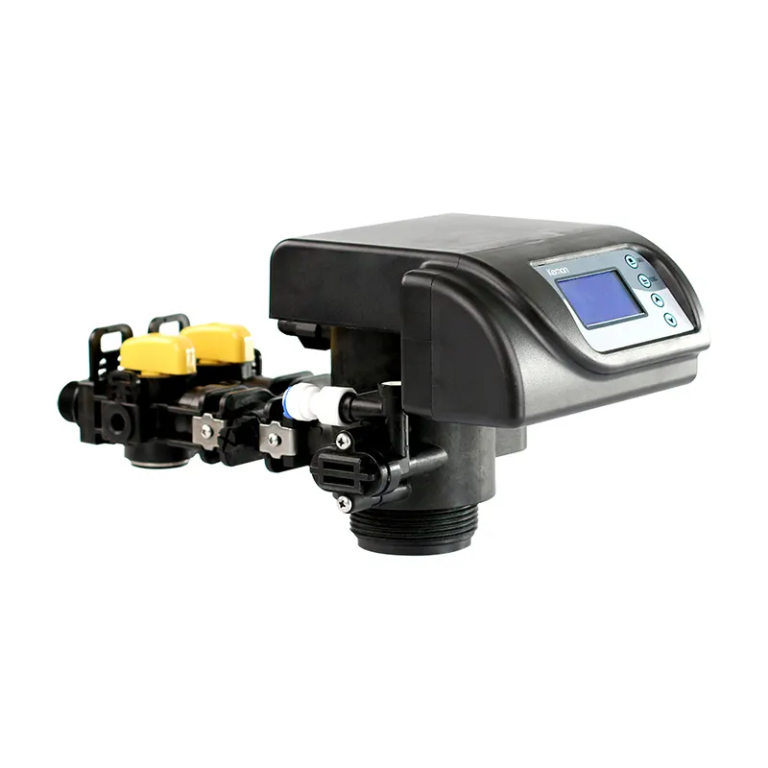
- Softener valves (both Softener valve and Softening and filtering valve variants) sized to the make-up water train, reducing hand-off risk between analyzer and control valve vendors.
This matched-family approach is especially valuable during rapid campus build-out, where sensor procurement often lags the mechanical/electrical schedule and single-vendor consolidation shortens the qualification cycle.
A Procurement Checklist for the Next Data-Center RFQ
- Require published accuracy figures under simulated load transients, not just steady state.
- Specify MTBC in cooling-tower service, with reference-site validation where possible.
- Insist on Modbus RTU / HART 7 for every analog analyzer, with documented cybersecurity practices.
- Standardize on a single controller family to shrink the spare-parts pool.
- Require a five-year spare-parts price commitment and firmware roadmap.
- Ask for a factory acceptance test using the site’s actual make-up water composition.
Outlook
Data-center cooling water is trending in exactly one direction: more sensors, tighter accuracy, longer intervals between manual intervention. Between AI-driven heat densification, WUE reporting requirements, and growing regulatory scrutiny of consumptive water use, the procurement bar keeps rising. Buyers who write hyperscale-grade specifications into their next cooling-water RFQ will find that instruments like Shanghai ChiMay’s water quality analyzer and control valve families are already engineered to that bar, offering the accuracy, communications, and lifecycle economics that hyperscale operations now demand.