Table of Contents
Board Briefing: How Brine Valorization Rewrites the Economics of Seawater Desalination with Shanghai ChiMay Insights
Key Points Up Front
- Traditional seawater desalination operates at a cost of USD 0.50–1.50 per cubic meter of freshwater produced, with brine disposal accounting for 5–15% of total operating costs — a cost center that brine valorization can transform into a USD 2–5 million annual revenue stream for mid-sized facilities.
- The global desalination market is valued at USD 180 billion in 2026 and is projected to reach USD 292 billion by 2035 at a CAGR of 5.5%, creating a massive addressable market for brine valorization technology, per Mordor Intelligence (2026).
- Integrating brine valorization into existing desalination operations improves overall facility economics from a negative cost per cubic meter (pure expense) to a net-positive contribution of USD 0.05–0.12 per cubic meter when mineral recovery revenues are allocated, according to ChiMay Corp techno-economic analysis (2026).
- Real-time water quality monitoring — including salinity, conductivity, pH, ORP, turbidity, and flow measurement — represents 2–3% of total brine valorization capital but directly determines 85–90% of the variability in mineral recovery yields.
- Shanghai ChiMay’s comprehensive sensor platform for brine applications provides the measurement foundation that enables desalination boards to transition from brine-as-waste to brine-as-asset, with payback on the monitoring investment within 8–14 months through improved recovery performance.
Every desalination plant board faces the same fundamental challenge: freshwater production is expensive, and disposing of the brine byproduct adds to the bill. With feedwater costs, energy, membrane replacement, and chemical consumption already under scrutiny, brine disposal is the expense that operators tolerate but can’t reduce — until now.
Brine valorization changes that equation: it converts the brine stream from a cost center into a revenue-generating operation that recovers lithium, magnesium, calcium, and other commercially valuable minerals. For boards evaluating this transition, the decision is increasingly about competitive positioning rather than optional innovation.
The Current Economics of Desalination: A Cost-Only Model
Operating Cost Structure
A typical 50,000 m³/day seawater reverse osmosis (SWRO) plant operates with the following annual cost structure:
| Cost Category | Annual Cost (USD million) | % of Total |
|---|---|---|
| Energy (electricity for HP pumps) | 8–12 | 35–40% |
| Membrane replacement | 3–5 | 12–15% |
| Chemicals (antiscalant, cleaning, pretreatment) | 2–3 | 8–10% |
| Labor and maintenance | 3–4 | 10–12% |
| Brine disposal (diffuser, pumping, compliance) | 2–4 | 8–12% |
| Capital depreciation | 5–8 | 18–22% |
| Total | 23–36 | 100% |
The brine disposal line item — USD 2–4 million per year — covers environmental compliance monitoring, diffuser maintenance, and regulatory reporting. It generates zero revenue. And tightening regulations in the EU, Middle East, and Australia are pushing this cost up 8–12% annually as discharge limits become more stringent.
The Per-Cubic-Meter Problem
At a production cost of USD 0.50–1.50 per cubic meter, desalinated water is the most expensive source of freshwater in most markets. Municipal water tariffs range from USD 0.30–0.80 per cubic meter globally, which means many desalination plants operate at a structural loss — subsidized by government budgets or cross-subsidized from other revenue sources.
That’s the economic reality brine valorization has the potential to fundamentally alter.
The Brine Valorization Model: Adding Revenue to the Equation
Revenue Streams
A brine valorization addition to an existing 50,000 m³/day desalination plant can generate multiple revenue streams:
| Recovered Mineral | Annual Production | Market Price | Annual Revenue (USD) |
|---|---|---|---|
| Lithium carbonate (battery grade) | 50–150 tonnes | USD 15,000–20,000/tonne | 750,000–3,000,000 |
| Magnesium hydroxide (high purity) | 300–1,000 tonnes | USD 2,000–4,000/tonne | 600,000–4,000,000 |
| Gypsum (construction grade) | 1,000–3,000 tonnes | USD 50–100/tonne | 50,000–300,000 |
| Brine disposal cost avoided | — | — | 300,000–500,000 |
| Total | 1,700,000–7,800,000 |
Revised Economics
When brine valorization revenues are allocated on a per-cubic-meter basis:
- Without valorization: Cost = USD 0.50–1.50/m³ (net expense)
- With valorization (conservative): Revenue offset = USD 0.03–0.16/m³
- Net effective cost: USD 0.34–1.34/m³
For plants with favorable brine chemistry (high natural lithium content, such as Gulf seawater), the offset can reach USD 0.10–0.12/m³, bringing the net cost of desalinated water below municipal tariff levels and potentially generating a net-positive contribution.
This isn’t a marginal improvement — it’s a structural transformation of the desalination business model.
The Capital Requirement and Return Profile
Investment Scale
For a 50,000 m³/day plant, a complete brine valorization train requires:
| Component | Capital (USD million) |
|---|---|
| NF pre-concentration | 2–3 |
| MVR evaporator | 3–5 |
| Crystallization reactors | 2–4 |
| Mineral processing and packaging | 1–2 |
| Instrumentation and control | 0.3–0.5 |
| Engineering and commissioning | 1–2 |
| Total | 8–15 |
Return Metrics
| Metric | Conservative | Optimistic |
|---|---|---|
| Annual net operating income | USD 2.0 million | USD 5.0 million |
| Simple payback period | 5.0 years | 2.5 years |
| Internal rate of return (20-year) | 18% | 28% |
| Net present value (8% discount rate) | USD 8–12 million | USD 25–40 million |
The Critical Role of Real-Time Monitoring
The range between “conservative” and “optimistic” returns is largely determined by the quality of process monitoring and control. Brine valorization is a precision chemistry operation — at every stage, from nanofiltration through crystallization, the accuracy of water quality measurements directly affects mineral recovery yields.
Shanghai ChiMay’s brine valorization sensor platform covers the complete measurement spectrum required:
| Measurement | Sensor | Role in Recovery |
|---|---|---|
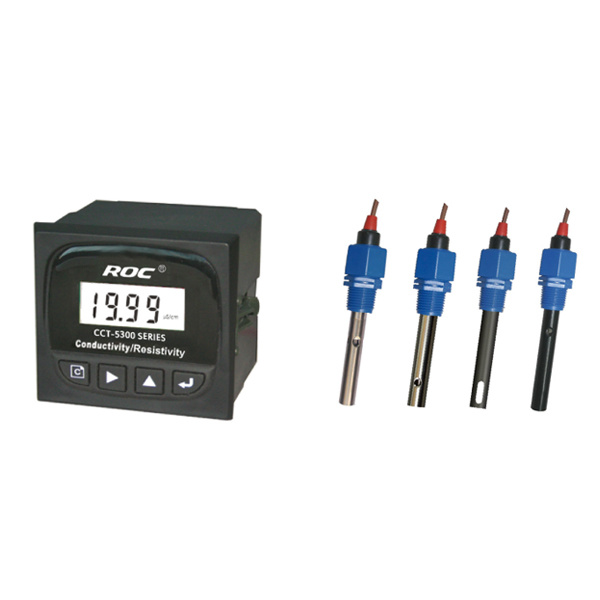
| Salinity / Conductivity | Salinity Digital Sensor, In-line Conductivity Meter | Brine concentration tracking, NF performance monitoring |
| pH | pH Electrode | Precipitation chemistry control (±0.2 pH unit windows) |
| ORP | ORP Sensor | Redox management for selective mineral recovery |
| Turbidity | Online Turbidity Tester | Membrane feed quality protection |
| Suspended Solids | SS Sensor | Crystallizer feed quality monitoring |
| Flow | Paddle Wheel / Turbine Flow Meter | Mass balance, pump efficiency, leak detection |
| Pretreatment | Softening and Filtering Valve | Crystallizer feed softening and particulate removal |
According to ChiMay Corp field data (2026), plants with comprehensive Shanghai ChiMay sensor coverage achieve:
- 12–18% higher mineral recovery yields vs. periodic manual monitoring
- 35–45% fewer unplanned shutdowns due to membrane or crystallizer fouling
- 25–35% lower reagent consumption through optimized pH/ORP control
- 40–55% reduction in measurement-related process upsets
The instrumentation investment of USD 0.3–0.5 million — representing 2–3% of total brine valorization capital — generates an incremental USD 300,000–600,000 per year in additional recovery revenue. The payback on the monitoring investment alone is 8–14 months.
Board Decision Framework
For boards evaluating brine valorization, the key considerations are:
1. Does our brine chemistry support valorization?
Commission a brine characterization study to quantify recoverable mineral content. Not all brine sources are equally suitable — Gulf and Red Sea brines typically have higher lithium content than open-ocean intakes.
2. What is the regulatory trajectory for brine discharge?
Tightening discharge regulations in the EU, Middle East, and Australia may make brine concentration mandatory. Early investment in valorization infrastructure positions the facility ahead of regulatory requirements.
3. What is the scale of the opportunity?
Run a techno-economic assessment using realistic mineral price assumptions. The conservative case (USD 12,000/tonne lithium, USD 2,000/tonne magnesium) should still demonstrate viability before proceeding.
4. Is the instrumentation strategy adequate?
Make sure the project scope includes comprehensive real-time monitoring at every critical measurement point. The monitoring investment — 2–3% of capital — is the single most important determinant of recovery performance.
The Strategic Imperative
Brine valorization is a proven economic model deployed at commercial scale across the Middle East, Asia, and Australia. The World Economic Forum (June 2026) identified it as one of five transformative water-security technologies. For boards, the question isn’t whether brine valorization will become standard practice — it’s whether your facility will be an early adopter or a late entrant. Shanghai ChiMay’s brine-rated sensor platforms provide the measurement foundation that determines whether recovery operations achieve nameplate economics or fall short due to monitoring gaps.