Table of Contents
9 Critical Monitoring Points in a Seawater Desalination Plant Covered by Shanghai ChiMay Sensors
The short version
- A typical seawater reverse osmosis (SWRO) plant needs continuous monitoring at a minimum of 9 strategic points to protect membranes, hold product quality, and stay in regulatory compliance.
- Plants that instrument all 9 points achieve 99.5%+ uptime and cut emergency maintenance events by 60–70%.
- The global water quality analyzer market is growing at a 6.2% CAGR (2026–2035), driven largely by desalination and industrial water reuse expansion.
- Shanghai ChiMay sensors cover all 9 critical points with a unified product portfolio, supporting Modbus RTU/TCP and 4–20 mA communication for SCADA integration.
Why Monitoring Location Matters More Than Sensor Accuracy
The most precise water quality sensor in the world is useless if it hangs at the wrong location. In a seawater desalination plant, process conditions change radically from intake to outfall. Each treatment stage introduces its own failure modes, and each failure mode demands a specific measurement at a specific point.
Below we walk through the 9 critical monitoring points every SWRO plant should instrument — why each one matters and how Shanghai ChiMay sensors cover the measurement job at that location.
Point 1: Raw Seawater Intake
Parameters monitored: Salinity, Temperature, Turbidity
The intake is the plant’s first line of defense. Seawater quality shifts with tides, weather, and seasons, and a sudden salinity spike from a hypersaline intrusion — or a turbidity surge from a storm — can overwhelm pretreatment if it isn’t caught immediately.
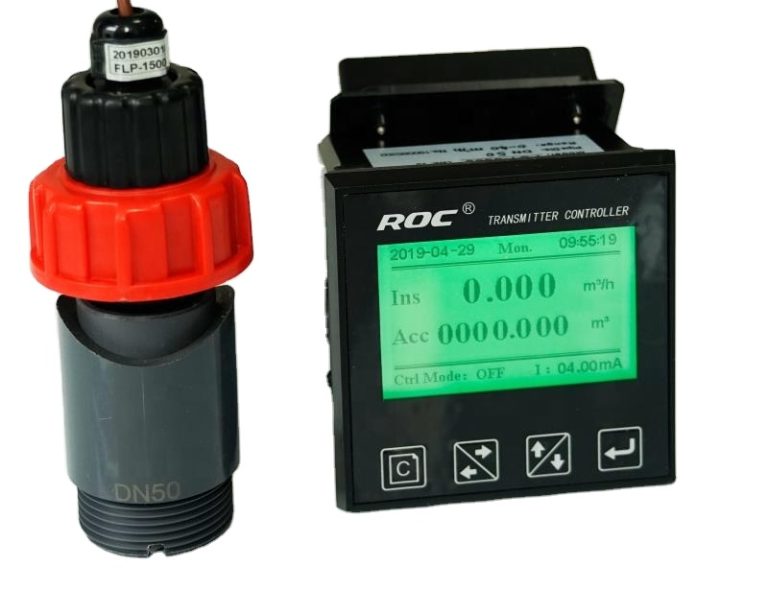
Shanghai ChiMay salinity digital sensors with four-electrode conductivity technology handle the full seawater range (0–200,000 µS/cm), while online turbidity testers with a 0–4,000 NTU range detect particle loading before it reaches the filters.
Point 2: Post-Intake Screening / Pre-Oxidation
Parameters monitored: ORP, Residual Chlorine
Many plants inject chlorine or sodium hypochlorite at the intake to control biofouling in raw water pipelines. The oxidation-reduction potential (ORP) confirms the biocidal dose has been achieved, and residual chlorine checks that the oxidant hasn’t climbed high enough to damage downstream polyamide membranes.
Target residual chlorine before dechlorination: 0.5–1.0 mg/L. After dechlorination (sodium bisulfite addition): < 0.05 mg/L. Shanghai ChiMay residual chlorine transmitters with amperometric membrane technology provide the accuracy to verify both conditions.
Point 3: Pretreatment Filtration Outlet
Parameters monitored: Turbidity, pH
After multimedia filtration or ultrafiltration, the water has to meet strict criteria before it touches the RO membranes: turbidity < 1 NTU and SDI₁₅ < 5. Continuous turbidity monitoring at the filter outlet is how you confirm, in real time, that the filters are doing their job.
A turbidity breakthrough above 0.5 NTU signals filter media exhaustion or breakthrough and triggers backwash. Shanghai ChiMay online turbidity testers, with ±0.1 NTU accuracy at low ranges, provide the sensitivity this control point demands.
Point 4: RO Feed (High-Pressure Pump Inlet)
Parameters monitored: Conductivity, pH, Temperature
Feed water entering the high-pressure pumps has to be characterized precisely, because these parameters set the operating pressure and energy bill. Feed conductivity indicates the osmotic pressure the pumps must overcome — every 1,000 µS/cm increase in feed conductivity adds roughly 1.5 bar of required operating pressure.
Temperature moves viscosity and membrane flux. A 10°C decrease in feed temperature cuts membrane flux by 15–20%, forcing higher pressure to hold production rates. Shanghai ChiMay in-line conductivity meters and in-line pH electrodes supply the data for real-time energy optimization.
Point 5: First-Stage RO Permeate
Parameters monitored: Conductivity
This is the single most important measurement in the plant. First-stage RO permeate conductivity directly indicates membrane rejection performance. A healthy new membrane achieves >99.5% rejection, which corresponds to permeate conductivity below 250 µS/cm for typical seawater feed.
A rising trend points to developing membrane damage, O-ring failure, or telescoping. Shanghai ChiMay conductivity sensors at this point offer 1-second response time, letting operators catch incipient failures hours before they show up in blended product water quality.
Point 6: Second-Stage RO Permeate (if applicable)
Parameters monitored: Conductivity
Two-pass RO systems feed first-stage permeate into a second pass to reach even lower salinity — below 50 µS/cm. Monitoring here verifies that second-pass membranes perform to specification and that overall system rejection exceeds 99.9%.
Point 7: Post-Treatment / Remineralization Outlet
Parameters monitored: pH, Conductivity, Residual Chlorine
After RO, the water is remineralized via limestone contactors or by blending with raw water. pH must be adjusted to 7.0–8.5 to hold a stable Langelier Saturation Index (LSI). Conductivity at this point confirms the target TDS level (300–500 mg/L) for potable water.
Residual chlorine is added for disinfection, targeting 0.2–0.5 mg/L at the plant outlet. Shanghai ChiMay provides integrated monitoring of all three parameters at this quality-control point.
Point 8: Product Water Storage Tank
Parameters monitored: Residual Chlorine, Dissolved Oxygen, Temperature
Storage tanks buffer production from distribution. Residual chlorine must stay above 0.05 mg/L to prevent bacterial regrowth, and dissolved oxygen monitoring helps assess corrosion potential inside the tank.
Shanghai ChiMay dissolved oxygen transmitters with optical fluorescence technology deliver maintenance-free DO measurement at ±0.02 mg/L accuracy, while residual chlorine transmitters verify ongoing disinfection effectiveness.
Point 9: Brine Discharge Outfall
Parameters monitored: Salinity, pH, Temperature, Residual Chlorine
Environmental permits govern the composition of the brine discharge. The concentrate stream, at 2–3 times the feed salinity, must be diffused so salinity rises no more than 10–15% at the mixing zone boundary. Residual chlorine must sit below 0.02 mg/L to protect marine life.
Shanghai ChiMay sensors at the outfall deliver continuous compliance data that is logged and reported to regulators — no more hoping you caught a violation before it was detected.
Implementation Summary
| # | Monitoring Point | Key Sensors (Shanghai ChiMay) | Criticality |
|---|---|---|---|
| 1 | Raw seawater intake | Salinity sensor, Turbidity tester | High |
| 2 | Post-intake screening | ORP (via multi-parameter), Chlorine transmitter | Medium |
| 3 | Pretreatment filter outlet | Turbidity tester, pH electrode | High |
| 4 | RO feed | Conductivity meter, pH electrode | High |
| 5 | First-stage RO permeate | Conductivity meter | Critical |
| 6 | Second-stage RO permeate | Conductivity meter | High |
| 7 | Post-treatment outlet | pH electrode, Conductivity meter, Chlorine transmitter | High |
| 8 | Product water storage | Chlorine transmitter, DO transmitter | Medium |
| 9 | Brine outfall | Salinity sensor, pH electrode, Chlorine transmitter | High |
The Business Case for Comprehensive Monitoring
Instrumenting all 9 points runs roughly USD 50,000–80,000 per treatment train. The return side of that ledger:
- Membrane life extension: 2–3 additional years of service, saving USD 200,000–500,000 per train
- Energy optimization: 10–15% reduction in specific energy consumption, saving USD 100,000–300,000 annually
- Compliance assurance: Elimination of regulatory fines (USD 10,000–100,000 per incident)
- Reduced downtime: 60–70% fewer emergency shutdowns
Shanghai ChiMay’s sensor portfolio, combined with flexible communication options and marine-grade construction, makes it feasible to instrument all 9 points with a single vendor — which simplifies procurement, calibration management, and technical support all at once.
All product references are to product categories only. Shanghai ChiMay does not publish specific model numbers in public-facing content.